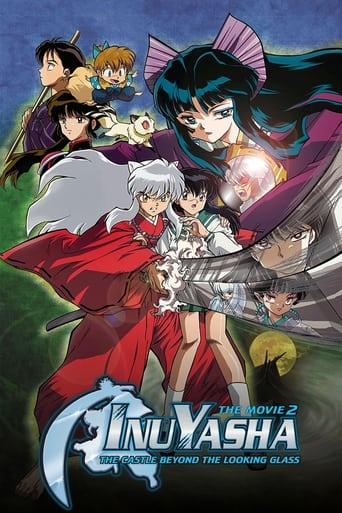
Inuyasha the Movie 2: The Castle Beyond the Looking Glass (2002)
犬夜叉 鏡の中の夢幻城
With their most formidable foe vanquished, Inuyasha and his comrades begin returning to their everyday lives. But their peace is fleeting as another adversary emerges: Kaguya, the self-proclaimed princess from the Moon of Legend, hatches a plot to plunge the world into an eternal night of the full moon. Inuyasha, Kagome, Miroku, Sango and Shippou must reunite to confront the new menace.
- Date of release
- 2002-12-22
- TMDB
- 7.7 / 10 (168)
- Runtime
- 1h 40m
- Genres
- Action, Animation, Adventure, Fantasy
- Director
- Toshiya Shinohara
- Collection
- Inuyasha Collection
Casting
- Kappei Yamaguchi — Inuyasha (voice)
- Satsuki Yukino — Kagome Higurashi (voice)
- Koji Tsujitani — Miroku (voice)
- Houko Kuwashima — Sango (voice)
- Kumiko Watanabe — Shippo (voice)
- Noriko Hidaka — Kikyo (voice)
- Kenichi Ogata — Myōga (voice)
- Toshiyuki Morikawa — Naraku (voice)
- Izumi Ōgami — Kagura (voice)
- Yukana — Kanna (voice)
- Akiko Yajima — Kohaku (voice)
- Mieko Harada — Kaguya (voice)
Interesting facts
- Based on: Inuyasha
Inuyasha the Movie: The Castle Beyond the Looking Glass is a 2002 Japanese animated fantasy adventure film based on the Inuyasha manga series written and illustrated by Rumiko Takahashi. The film is directed by Toshiya Shinohara, written by Katsuyuki Sumisawa, and produced by Sunrise. It was released in Japan on December 21, 2002, and in the United States on December 28, 2004.
Production
The sequel followed the popularity of the Inuyasha television series. According to Sunrise, the filmmakers placed greater emphasis on action sequences than in the first film. The original story drew upon The Tale of the Bamboo Cutter, with manga creator Rumiko Takahashi participating in the development of the scenario.
The film was produced by Sunrise and shared several principal staff members with Inuyasha the Movie: Affections Touching Across Time (2001). Toshiya Shinohara returned as director, Katsuyuki Sumisawa wrote the screenplay, and Kaoru Wada composed the music. Hideyuki Motohashi and Yoshihito Hishinuma were credited as character designers, with Motohashi also serving as chief animation director.
A two-volume film-comic adaptation was published in Japan by Shogakukan under its Shōnen Sunday Comics Visual Selection imprint in July and August 2003.
The film's theme song, "Yurayura", was performed by Every Little Thing, written by Kaori Mochida, composed by Kunio Tago and arranged by Yasuo Otani, Masafumi Nakao and Ichiro Ito. The duo also performed the insert song "Ai no Uta" (愛の謳), written by Mochida, composed by Tago and arranged by Akira Murata.
The film's original soundtrack, composed by Kaoru Wada, was released by Avex Mode on 18 December 2002, three days before the film's Japanese theatrical premiere. The album contains 37 tracks, with a total running time of 55 minutes and 53 seconds.
Read on Wikipedia · Text from Wikipedia, CC BY-SA 4.0. Data from Wikidata.
Recommended
- Inuyasha the Movie 4: Fire on the Mystic Island 2004 · ★ 7.6
- Inuyasha the Movie 3: Swords of an Honorable Ruler 2003 · ★ 7.7
- X 1996 · ★ 6.2
- Inuyasha the Movie: Affections Touching Across Time 2001 · ★ 7.5
- One Piece: Heart of Gold 2016 · ★ 7.3
- Legend of the Millennium Dragon 2011 · ★ 6.2
- Demon City Shinjuku 1988 · ★ 6.0
- Fatal Fury: The Motion Picture 1994 · ★ 7.4
- A Thousand and One Nights 1969 · ★ 6.6
- Fairy Tail: Dragon Cry 2017 · ★ 6.6
- The Garden of Sinners: A Study in Murder - Part 2 2009 · ★ 7.1
- Baki Hanma VS Kengan Ashura 2024 · ★ 7.7