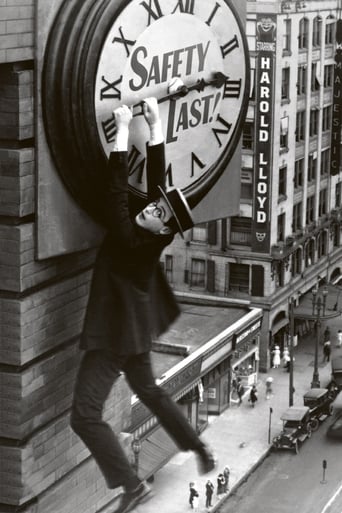
Safety Last! (1923)
You're Going to Explode With "Safety Laughs" when You see This Fun Bomb.
When a store clerk organizes a contest to climb the outside of a tall building, circumstances force him to make the perilous climb himself.
- Date of release
- 1923-03-12
- TMDB
- 7.7 / 10 (611)
- Runtime
- 1h 13m
- Genres
- Comedy, Romance, Thriller
- Director
- Fred C. Newmeyer, Sam Taylor
Casting
- Harold Lloyd — The Boy
- Mildred Davis — The Girl
- Bill Strother — The Pal
- Noah Young — The Law
- Westcott Clarke — The Floorwalker
- Roy Brooks — Man Laughing from Window (uncredited)
- Mickey Daniels — Newsboy with Freckles (uncredited)
- Richard Daniels — Worker with Acetylene Torch (uncredited)
- Ray Erlenborn — Newsboy with Cap (uncredited)
- William Gillespie — General Manager's Assistant (uncredited)
- Helen Gilmore — Department Store Customer (uncredited)
- Wally Howe — Man with Flowers / Studio Photographer (uncredited)
Interesting facts
- Budget: $121K
Safety Last! is a 1923 American silent romantic comedy film starring Harold Lloyd. It includes one of the most famous images from the silent-film era: Lloyd clutching the hands of a large clock as he dangles from the outside of a skyscraper above moving traffic. The film was highly successful and critically hailed, and it cemented Lloyd's status as a major figure in early motion pictures. It is still popular at revivals, and it is viewed today as one of the great film comedies.
Production
Lloyd hanging from a giant clock on the corner of a building was seen as an iconic image for him, though it was achieved through a certain degree of improvisation. Lloyd performed most of his own stuntwork, but a circus performer was used when The Boy hangs by a rope, and a stunt double – sometimes Bill Strother, who played "Limpy" Bill and was a steeplejack who inspired the sequence when Lloyd saw him climbing – was used in long shots.
A number of buildings from 1st Street to 9th Street in downtown Los Angeles, all of different heights, were used, with sets built on their roofs to match the facade of the main building, the International Bank Building at Temple and Spring Streets.
Stuntman Harvey Parry also appeared in the climactic sequence, a fact he revealed only after Lloyd's death. In the 1980 Thames Television series Hollywood, he discussed at length how the stunts were achieved.
Safety Last! was one of many silent films to film in a one-block alley near Hollywood and Cahuenga Boulevard. The alley was later renamed Chaplin-Keaton-Lloyd Alley in recognition of this and other films.
Read on Wikipedia · Text from Wikipedia, CC BY-SA 4.0. Data from Wikidata.
Recommended
- My Favorite Brunette 1947 · ★ 6.6
- Jingle Bell Heist 2025 · ★ 6.0
- Gotcha! 1985 · ★ 6.0
- 12 Gifts of Christmas 2015 · ★ 6.1
- My Christmas Dream 2016 · ★ 5.8
- The 27-Hour Day 2021 · ★ 7.1
- Vertigo 1958 · ★ 8.1
- The Great Muppet Caper 1981 · ★ 6.9
- Foul Play 1978 · ★ 6.3
- Falling for Christmas 2022 · ★ 6.2
- A Merry Christmas Wish 2022 · ★ 6.0
- Holiday Harmony 2022 · ★ 6.7