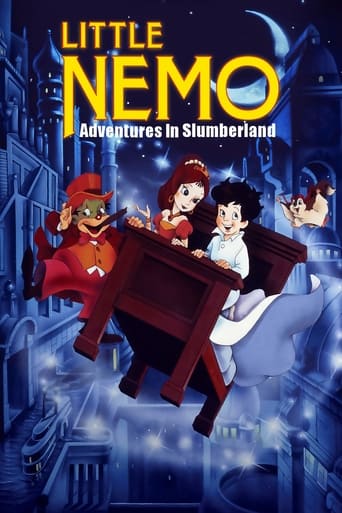
Little Nemo: Adventures in Slumberland (1989)
NEMO/ニモ
Take off on a wonderful adventure with "Little Nemo."
A little boy whose dreams transcend reality is sucked into his own fantasy, which is everything he has dreamed of, until he unleashes an old secret that may not only destroy this perfect dream world but reality itself.
- Date of release
- 1989-07-15
- TMDB
- 6.9 / 10 (189)
- Runtime
- 1h 35m
- Genres
- Adventure, Animation, Family, Fantasy
- Director
- Masami Hata, William T. Hurtz, Masanori Hata
Casting
- Takuma Gono — Nemo (voice)
- Chikao Ohtsuka — Flip / Professor Genius (voice)
- Hiroko Kasahara — Princess Camille (voice)
- Kenji Utsumi — King Morpheus (voice)
- Taro Ishida — Nightmare King (voice)
- Tessyo Genda — Nemo's Father (voice)
- Mari Yokoo — Nemo's Mother (voice)
- Hiroshi Otake — Oompa (voice)
- Keiichi Nanba — Oomp (voice)
- Masaharu Sato — Oompo (voice)
- Kozo Shioya — Oompe (voice)
- Hiroko Emori — Oompy (voice)
Interesting facts
- Awards: 0 · Nominations: 2
Little Nemo: Adventures in Slumberland is a 1989 animated musical fantasy film directed by Masami Hata and William Hurtz. Based on the comic strip Little Nemo in Slumberland by Winsor McCay, the film went through a lengthy development process with a number of screenwriters. Ultimately, the screenplay was credited to Chris Columbus and Richard Outten; the storyline and art style differed from the original version. The original soundtrack was penned by the Academy Award-winning Sherman Brothers. The film features the English dub voices of Gabriel Damon, Mickey Rooney, René Auberjonois, Danny Mann, Bernard Erhard, Laura Mooney, William E.
Production
Nemo was the brainchild of producer Yutaka Fujioka, then president of Tokyo Movie Shinsha (TMS). He had long realized the limitations of the animation business in Japan and wanted to enter the U.S. market, so he started a new animation studio and planned to distribute U.S.-Japan co-produced animation films worldwide.
He founded Telecom Animation Film in 1975, and embarked on a film adaptation of the legendary comic strip Little Nemo, which was so well known in the U.S. that two film adaptations were proposed during Walt Disney's lifetime.
As the first step towards realizing this project, in 1977 he personally flew to Monterey, California, to convince the McCay descendants to allow him to obtain the film rights, and he finally won it in the summer of 1978.
Fujioka had another dream: to make a "full animation" (not Japanese limited animation) film that could compete with Disney. For this purpose, Fujioka hired newcomers with no experience in Japanese TV animation and had them trained by Sadao Tsukioka, followed by Yasuo Ōtsuka. Incidentally, the 1980 pilot film was created by Tsukioka.
However, a lack of funding and inexperienced animators made it difficult to go into Nemo production, so he hired veteran staff away from other studios to work on Lupin the Third Part II, Hayao Miyazaki's film Lupin III: The Castle of Cagliostro, and Isao Takahata's film Jarinko Chie. And he frequently held screenings of those two films of Miyazaki and Takahata for film professionals in the U.S. to showcase his company's capabilities.
Read on Wikipedia · Text from Wikipedia, CC BY-SA 4.0. Data from Wikidata.
Recommended
- Welcome to Smelliville 2021 · ★ 6.7
- The Princess and the Goblin 1991 · ★ 5.8
- A Tooth Fairy Tale 2025 · ★ 8.5
- Bionicle 2: Legends of Metru Nui 2004 · ★ 5.9
- Crayon Shinchan the Movie: Fast Asleep! The Great Assault on the Dreaming World 2016 · ★ 6.6
- The Little Prince 2015 · ★ 7.6
- The Pagemaster 1994 · ★ 6.4
- Crayon Shinchan the Movie: Dangerous Honeymoon -The Lost Daddy- 2019 · ★ 7.0
- Brave Story 2006 · ★ 6.4
- Charlotte's Web 2: Wilbur's Great Adventure 2003 · ★ 6.0
- Pokémon the Movie: Hoopa and the Clash of Ages 2015 · ★ 6.8
- The Willoughbys 2020 · ★ 7.1