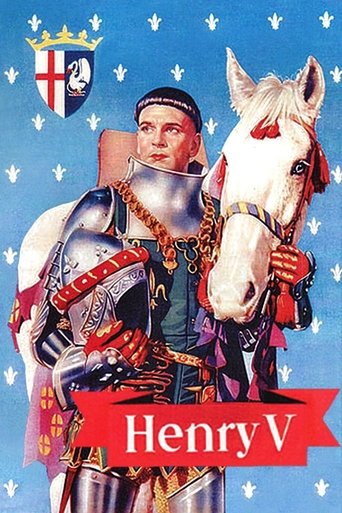
Henry V (1944)
The Chronicle History of King Henry the Fifth with His Battell Fought at Agincourt in France
In 1415, in the midst of the Hundred Years' War, the young King Henry V of England embarks on the conquest of France.
- Date of release
- 1944-11-24
- TMDB
- 6.7 / 10 (141)
- Runtime
- 2h 17m
- Genres
- History, Drama, War
- Director
- Laurence Olivier
Casting
- Laurence Olivier — King Henry
- Renée Asherson — Princess Katherine
- Ralph Truman — Mountjoy - The French Herald
- Ernest Thesiger — Duke of Berri - French Ambassador
- Frederick Cooper — Corporal Nym
- Robert Helpmann — Bishop of Ely
- Leslie Banks — Chorus
- Felix Aylmer — Archbishop of Canterbury
- Robert Newton — Ancient Pistol
- Freda Jackson — Mistress Quickly
- George Cole — Boy
- Leo Genn — The Constable of France
Interesting facts
- Budget: £475K
- Based on: Henry V
- Awards: 2 · Nominations: 4. Including: National Board of Review: Top Ten Films; National Board of Review Award for Best Film
Henry V is a 1944 British film adaptation of William Shakespeare's play. The film is directed, co-written, produced by, and stars Laurence Olivier in the title role. It was Olivier's first film directorial effort. The cast also features Renée Asherson as Katherine, Robert Newton as Pistol, and Leslie Banks as the chorus. The play was adapted for the screen by Olivier, Dallas Bower, and Alan Dent. The score was composed by William Walton.
Production
Winston Churchill instructed Olivier to fashion the film as morale-boosting propaganda for British troops fighting World War II. The making and release of the film coincided with the Allied invasion of Normandy and push into France. An early preview trailer of the film showed contemporary London just before cutting to the film's aerial footage of London in 1600. The film was meant to cost £350,000 but ended up costing nearly £500,000.
Much of the film's impact comes from the Technicolor cinematography (using the only Technicolor camera in the U.K. at the time), spectacular period costumes and a unique blend of stylized settings, miniatures and location shooting. The film begins with a handbill floating out of the sky setting the date—the first of May 1600–and the occasion. This dissolves into detailed miniature model of London, with boats moving on the Thames.
The Chorus now invokes our imagination to fly past the fleet, barely visible far below in a Channel filled with fog, to the court of France, where Charles VI is attended by various nobles, including the "Duke of Berri", who is examining an illuminated volume with a magnifying glass in one hand and a clove-studded orange pomander in the other.
The setting becomes more natural in the dark night before Agincourt, when Henry walks through the sleeping camp to see how it goes with his men. The Battle of Agincourt takes place in a realistic setting (filmed in Ireland), in natural fields and forests, and dialogue is delivered from the backs of restive chargers.
We next see the negotiations for the Treaty of Troyes, and the setting is used to great effect to clarify and increase the impact of the Duke of Burgundy's speech about the sorry state of France. Although it is spring, the camera moves out through a window to pan over a painting of the neglected countryside, specifically illustrating each line of the speech and pausing on the neglected children before panning back up to the château.
Read on Wikipedia · Text from Wikipedia, CC BY-SA 4.0. Data from Wikidata.
Recommended
- Henry V 1989 · ★ 7.1
- Peterloo 2018 · ★ 6.7
- A Call to Spy 2020 · ★ 6.8
- Master and Commander: The Far Side of the World 2003 · ★ 7.2
- The Last Valley 1971 · ★ 6.5
- King Arthur 2004 · ★ 6.3
- The Alamo 2004 · ★ 5.8
- The Alamo 1960 · ★ 7.1
- Passage to Marseille 1944 · ★ 6.7
- Victoria & Abdul 2017 · ★ 6.9
- The Scarlet and the Black 1983 · ★ 7.1
- Alexander the Great 1956 · ★ 6.1