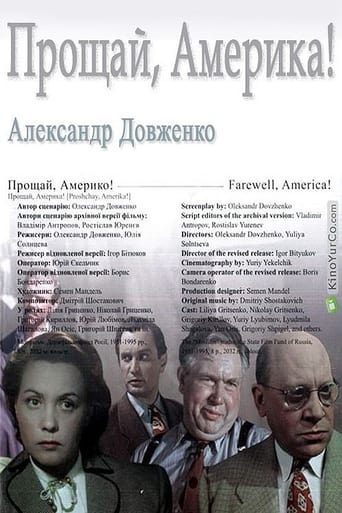
Farewell, America! (1951)
Прощай, Америка!
An unfinished film by Oleksandr Dovzhenko, the film is a political lampoon based on the book entitled The Truth about US Diplomats, written in 1949 by the American writer Annabel Bukar. It exposes the underhanded actions of US Embassy personnel in Moscow at the onset of the Cold War. Dovzhenko managed to shoot only a half of the film, mainly the scenes that take place in the American Embassy.
- Date of release
- 1951-01-01
- TMDB
- 4.8 / 10 (6)
- Runtime
- 1h 10m
- Genres
- Drama, Comedy
- Director
- Alexander Dovzhenko
Casting
- Liliya Gritsenko — Anna Badford
- Nikolai Gritsenko — Armand Haward
- Yuri Lyubimov
- Lyudmila Shagalova
- Grigoriy Shpigel
- Gotlib Roninson
- Yan Yanakiyev
- Rostislav Yurenev — Himself (introduction)
- Aleksandr Polinskiy — Murrow
- Nikolay Korshunov — Officer in the embassy
- Konstantin Mikhailov — Robert Divers
Interesting facts
Farewell, America is a 1951 Soviet propaganda drama film directed by Aleksandr Dovzhenko. An adaptation of the book The Truth about American Diplomats by American journalist and defector to the Soviet Union Annabelle Bucar, the film was abruptly shut down halfway through its production at Mosfilm studios. In 1996, the film was restored by the Gosfilmofond state archive before having its first screening at the Berlin Film Festival.
Production
In February 1948 Anabelle Bucar, an assistant in the USIS office of the U.S. Embassy in Moscow, resigned from her office and sought political asylum in the USSR. Bucar's defection came after she had begun an affair with the actor and operetta singer Konstantin Lapshin; the two later married, and Bucar received an apartment in Moscow.
In February 1950, speaking before the committee that was accepting the script, Dovzhenko said that he wanted to make a film about Americans, describing them as the "antipodes" of Soviet reality. An acting ensemble was brought in for the shoot, led by Nikolai Gritsenko and his sister Liliya.
The unfinished project would become Dovzhenko's last film. Afterwards, he did not film anything until his death, instead concentrating on literary work and script preparation. According to several film historians, the suspension of filming broke the director morally and had a detrimental effect on his health. In 1956, Dovzhenko died of a heart attack.
Read on Wikipedia · Text from Wikipedia, CC BY-SA 4.0. Data from Wikidata.
Recommended
- SubUrbia 1997 · ★ 6.2
- Hooking Up 2020 · ★ 6.3
- CQ 2001 · ★ 5.9
- The Game of Truth 2013 · ★ 6.3
- Family Weekend 2013 · ★ 6.3
- My Own Love Song 2010 · ★ 6.2
- Tyler Perry's Madea on the Run - The Play 2017 · ★ 7.5
- The House of Tomorrow 2019 · ★ 6.8
- On Becoming a Guinea Fowl 2024 · ★ 7.5
- Treasure 2024 · ★ 6.5
- Somewhere in Queens 2023 · ★ 6.3
- Landline 2017 · ★ 6.2