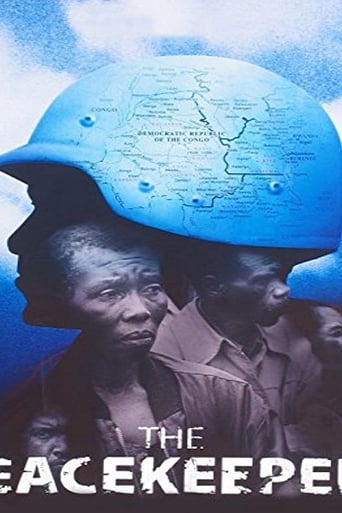
The Peacekeepers (2005)
With unprecedented access to the UN Department of Peacekeeping, The Peacekeepers provides an intimate and dramatic portrait of the struggle to save "a failed state" The film follows the determined and often desperate maneuvers to avert another Rwandan disaster, this time in the Democratic Republic of Congo (the DRC). Focusing on the UN mission, the film cuts back and forth between the UN headquarters in New York and events on the ground in the DRC. We are with the peacekeepers in the "Crisis Room" as they balance the risk of loss of life on the ground with the enormous sums of money required from uncertain donor countries. We are with UN troops as the northeast Congo erupts and the future of the DRC, if not all of central Africa, hangs in the balance. In the background, but often impinging on peacekeeping decisions, are the painful memory of Rwanda, the worsening crisis in Iraq, global terrorism, and American hegemony in world affairs.
- Date of release
- 2005-04-29
- TMDB
- 9.5 / 10 (2)
- Runtime
- 1h 23m
- Genres
- Documentary
- Director
- Paul Cowan
Casting
- Karen Feiertag — Narrator
- Kofi Annan — Himself
Interesting facts
The Peacekeepers is a 2005 documentary film directed by Paul Cowan, following the United Nations mission in the Democratic Republic of the Congo in the Democratic Republic of Congo between 2002 and 2004. The film portrays the attempts of UN Peacekeepers to avert a crisis similar to Rwanda in 1994. The film mixes footage from the actual conflict with that of UN officials behind the lines, to give a comprehensive portrayal of the conflict.
Filming
Set 3 years into the start of the Ituri conflict, the film is an in-depth look into the violent conflicts taking place in the region borne out of the Rwandan genocide, where ethnic tensions, a massive influx of arms, and the formation of warlord-led militias plagued the fragile country of the Democratic Republic of Congo between 1999 and 2003.
The Congo mission by 2002 was non-military and consisting of unarmed military observers reporting on the conflict, but not actively engaging combatants. Since the 1999 to 2002, the United Nations has spent over $6 million USD to keep the peace in the region, but local warlords still continue to use violence as a means of controlling the population, often resulting in entire villages being massacred.
The province of Bunia becomes sight of the Bogoro Massacre, in which some 200 villagers are killed, many of them hacked to death with machetes traditionally used by local militia. UN investigators are sent to the area to report on the situation, as rumours of Ugandan troops allowing the massacre to happen makes the UN question whether Uganda has ulterior motives in the region.
Before a French force is able to arrive, Bunia erupts into a war zone among the militants in the region, causing a wave of refugees to flee from the countryside to into the city. The Uruguayan force, unable to engage the militias, are stationed at the UN headquarters and airport in Kinshasa. Due to the violence, refugees flood in into both UN compounds to seek refuge from the fighting.
As the situation on the ground intensifies, UN forces are allowed a chapter 7 mandate, the ability to shoot on site against any forces they deem a threat. French-led military operations in the area stabilizes the Ituri region, declaring Bunia "weapons free" for a period of time.
Read on Wikipedia · Text from Wikipedia, CC BY-SA 4.0. Data from Wikidata.
Recommended
- Room 237 2012 · ★ 6.1
- The Cave 2019 · ★ 7.2
- Welcome to Chechnya 2020 · ★ 7.0
- Zero Days 2016 · ★ 7.4
- For Sama 2019 · ★ 8.2
- The Kid Stays in the Picture 2002 · ★ 6.6
- Travis Scott: Look Mom I Can Fly 2019 · ★ 6.8
- Matangi / Maya / M.I.A. 2018 · ★ 7.5
- Disclosure 2020 · ★ 7.8
- Night Will Fall 2014 · ★ 7.6
- 78/52 2017 · ★ 7.1
- The Decline of Western Civilization Part II: The Metal Years 1988 · ★ 6.8