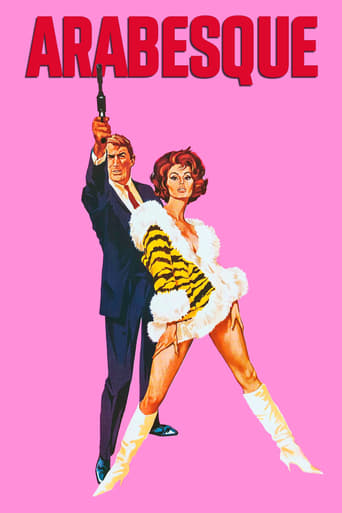
Arabesque (1966)
Ultra Mod. Ultra Mad. Ultra Mystery.
When a plot against a prominent Middle Eastern politician is uncovered, David Pollock, a professor of ancient hieroglyphics at Oxford University, is recruited to help expose the scheme. Pollock must find information believed to be in hieroglyphic code and must also contend with a mysterious man called Beshraavi. Meanwhile, Beshraavi's lover, Yasmin Azir, seems willing to aid Pollock -- but is she really on his side?
- Date of release
- 1966-05-04
- TMDB
- 6.3 / 10 (201)
- Runtime
- 1h 45m
- Genres
- Thriller, Comedy, Mystery, Action
- Director
- Stanley Donen
Casting
- Gregory Peck — Prof. David Pollock
- Sophia Loren — Yasmin Azir
- Alan Badel — Nejim Beshraavi
- Kieron Moore — Yussef Kasim
- Carl Duering — Prime Minister Hassan Jena
- John Merivale — Maj. Sylvester Pennington Sloane
- Duncan Lamont — Webster
- George Coulouris — Ragheeb
- Ernest Clark — Beauchamp
- Harold Kasket — Mohammed Lufti
- Windsor Davies — Policeman
- Jimmy Gardner — Helmsley
Interesting facts
- Box office: $5M
- Budget: $4.8M
- Earned 1× its budget
- Filmed in: Pinewood Studios
Arabesque is a 1966 American spy comedy thriller film produced and directed by Stanley Donen and starring Gregory Peck and Sophia Loren. The screenplay by Julian Mitchell, Stanley Price, and Peter Stone is based on the 1961 novel The Cipher by Alex Gordon. The film, along with Donen's immediately prior film Charade (1963), is usually described as being "Hitchcockian". It features as a protagonist an innocent and ordinary man thrust into dangerous and extraordinary situations. It was the last film of that genre which Donen would make.
Production
The original working title for the film was "Crisscross", which was later changed to "Cipher" before becoming Arabesque.
Producer/director Stanley Donen wanted Cary Grant for the role of Pollock after working with him in his previous film Charade, and the dialogue for Pollock was written with Grant in mind. However, Donen was later quoted as saying,
[Grant] didn't want to be in it ... It wasn't a good script and I didn't want to make it, but Gregory Peck and Sophia Loren, whom I loved, wanted to be in it and the studio implored me to make it, because, they said, 'It's ridiculous not to make a film with Peck and Sophia.' They said it would make money, and they were right.
Donen later estimated that $400,000 was spent on the script alone and cinematographer Christopher Challis recalled that the film went through several rewrites. Challis said that "The more the script was rewritten, the worse it got." With Peck and Loren already contracted to do the film, Challis recalled that Donen told him "Our only hope is to make it so visually exciting the audience will never have time to work out what the hell is going on".
Peter Stone, who was brought in very late to make improvements in the dialogue, said that Donen "shot it better than he ever shot any picture. Everything was shot as though it were a reflection in a Rolls-Royce headlamp." Donen described his technique in shooting the film:
Read on Wikipedia · Text from Wikipedia, CC BY-SA 4.0. Data from Wikidata.
Recommended
- Nick of Time 1995 · ★ 6.2
- Hitman: Agent 47 2015 · ★ 5.9
- The Long Kiss Goodnight 1996 · ★ 6.6
- Ava 2020 · ★ 5.8
- The Virtuoso 2021 · ★ 5.9
- Mechanic: Resurrection 2016 · ★ 6.1
- The Assignment 1997 · ★ 6.3
- The Oxford Murders 2008 · ★ 6.0
- Mindcage 2022 · ★ 5.8
- London Has Fallen 2016 · ★ 6.2
- The 51st State 2001 · ★ 6.1
- Cleaner 2007 · ★ 6.1