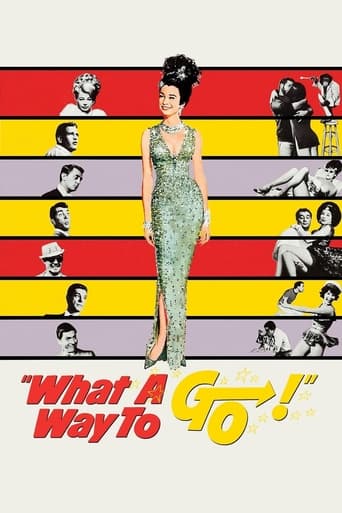
What a Way to Go! (1964)
What A Cast!... What A Past!... What A Show!...
A four-time widow discusses her four marriages, in which all of her husbands became incredibly rich and died prematurely because of their drive to be rich.
- Date of release
- 1964-07-02
- TMDB
- 7.1 / 10 (113)
- Runtime
- 1h 51m
- Genres
- Comedy, Romance
- Director
- J. Lee Thompson
Casting
- Shirley MacLaine — Louisa May Foster
- Paul Newman — Larry Flint
- Robert Mitchum — Rod Anderson Jr.
- Dean Martin — Leonard Crawley
- Gene Kelly — Pinky Benson
- Robert Cummings — Victor Stephanson
- Dick Van Dyke — Edgar Hopper
- Reginald Gardiner — Painter
- Margaret Dumont — Mrs. Foster
- Lou Nova — Trentino
- Fifi D'Orsay — Baroness
- Maurice Marsac — Rene
Interesting facts
- Awards: 0 · Nominations: 2
What a Way to Go! is a 1964 American black comedy film directed by J. Lee Thompson and starring Shirley MacLaine, Paul Newman, Robert Mitchum, Dean Martin, Gene Kelly, Bob Cummings and Dick Van Dyke.
Production
Publicist Arthur Jacobs wanted to move into film production. One of his clients was Marilyn Monroe who said she would appear in a movie Jacobs produced if she liked the story. He found I Love Louisa based on a story by Gwen Davis about a woman with six husbands. In June 1962, Darryl F.
In September 1962, Jacobs said that J. Lee Thompson, who was another client of his, would direct the film following The Mound Builders (which became Kings of the Sun). Jacobs wanted one of the "top three" stars in the world to play the lead, and "important names" to play the six husbands. No distributor had been signed. Later that month Thompson said he would make I Love Louisa with Elizabeth Taylor.
In January 1963, Thompson said he was confident about Frank Sinatra, Marlon Brando and David Niven playing husbands. In April 1963 Hedda Hopper reported that Steve McQueen would star in the film opposite Shirley MacLaine.
MacLaine was formally signed in July 1963. Also that month Jacobs announced he had signed a deal with 20th Century-Fox for the latter to finance and distribute. The production companies would be Jacob's Apjac and Thompson's Malibu Productions. The stars would be MacLaine, Dean Martin, Paul Newman, Robert Mitchum, Dick Van Dyke and Gene Kelly. Filming would start 8 August.
According to Mitchum, Frank Sinatra had wanted $500,000 for two weeks worth of work, so they offered the role to Mitchum instead. He agreed to do it because he liked working with MacLaine and Thompson (who had directed him in Cape Fear).
Read on Wikipedia · Text from Wikipedia, CC BY-SA 4.0. Data from Wikidata.
Recommended
- Love Is in the Air 2023 · ★ 6.2
- I Love You Again 1940 · ★ 7.2
- Girl on a Bicycle 2013 · ★ 5.9
- Let's Make Love 1960 · ★ 6.4
- Love, Weddings & Other Disasters 2020 · ★ 6.0
- The Thrill of It All 1963 · ★ 7.0
- Good Advice 2001 · ★ 5.9
- Christmas with You 2022 · ★ 5.9
- The Prince & Me 4: The Elephant Adventure 2010 · ★ 6.1
- What's Love Got to Do with It? 2023 · ★ 6.1
- Silk Stockings 1957 · ★ 6.8
- Fun with Dick and Jane 1977 · ★ 6.6