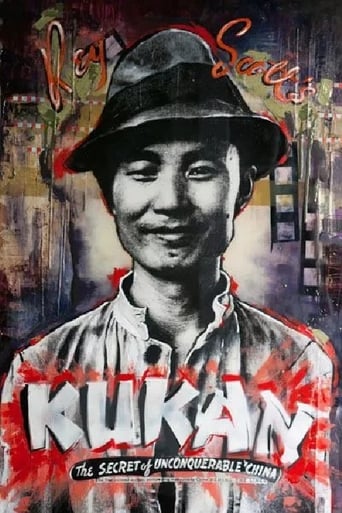
Kukan: The Battle Cry of China (1941)
Rey Scott received an Honorary Academy Award for this documentary "for his extraordinary achievement in producing Kukan, the film record of China's struggle, including its photography with a 16mm camera under the most difficult and dangerous conditions." Producer David O. Selznick thought so much of it, that he distributed KUKAN in 35mm, even after the film had already had an extensive run in 16mm.
- Date of release
- 1941-06-23
- TMDB
- 7.1 / 10 (9)
- Runtime
- 1h 2m
- Genres
- Documentary
- Director
- Rey Scott
Casting
- Niles Welch — Narrator (voice)
Interesting facts
Kukan is a 1941 American documentary film co-produced by Li Ling-Ai and Rey Scott, and directed by Scott about the Chinese resistance to Japanese aggression during the early part of World War II. Though Li served as co-producer and sponsor, she was credited as a "technical advisor" in its credits. The film was distributed in 16mm by Adventure Epics and given an Honorary Academy Award at the 14th Academy Awards.
Production background
Scott, a St. Louis native and foreign correspondent for London's Daily Telegraph, took a handheld 16mm camera and color film to war-torn China, where he traveled from Hong Kong to the wartime capital Chongqing, and then along the Burma Road to Lanzhou. From there, he ventured to Tibet, then back to Chongqing.
The final 20 minutes of Kukan consists of an aerial attack by Japanese bombers against the defenseless city of Chongqing from August 19–20, 1940. The bombing took up the film's final 20 minutes and showed some of the 200 tons of bombs dropped on the city. Scott captured his footage from a vantage point on the roof of the U.S. Embassy, which was near the center of the attack.
After arriving in Haiphong, Scott joins a truck convoy on "(a) highway from Dongang, on the railway in French Indochina, to Kweilin, capital of Kwangsi, via Nanning, able to take five-ton loads…"
The convoy makes a dash across the border at night to evade Japanese planes.
After crossing the border, the convoy enters rural China, Kwangsi (Guangxi) province.
Read on Wikipedia · Text from Wikipedia, CC BY-SA 4.0. Data from Wikidata.
Recommended
- Night Will Fall 2014 · ★ 7.6
- Fuck 2006 · ★ 6.4
- City of Ghosts 2017 · ★ 7.2
- McQueen 2018 · ★ 7.4
- The Godfather Family: A Look Inside 1990 · ★ 7.8
- The Battle of San Pietro 1945 · ★ 6.1
- In the Realms of the Unreal 2004 · ★ 7.2
- Why We Fight: Prelude to War 1942 · ★ 6.5
- Wolves Up Close with Bertie Gregory 2026 · ★ 7.3
- Feminists: What Were They Thinking? 2018 · ★ 7.5
- Visions of Light 1992 · ★ 7.0
- The Cutting Edge: The Magic of Movie Editing 2004 · ★ 7.0