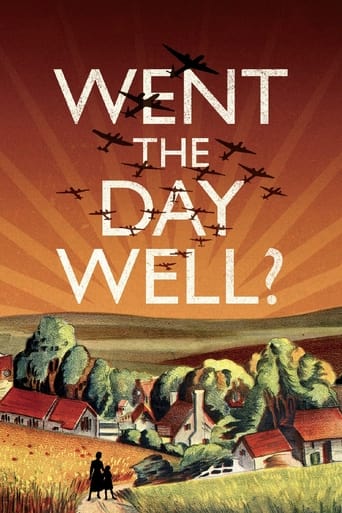
Went the Day Well? (48 Hours) (1942)
Went the Day Well?
Durante la Segunda Guerra Mundial, un grupo de soldados británicos llega a la aldea inglesa de Bramley End. Al principio son bien recibidos por los lugareños, pero muy pronto éstos empiezan a dudar de su identidad y de sus verdaderos propósitos. Cuando descubren que, en realidad, son soldados alemanes cuyo objetivo es ser la avanzadilla de la invasión de Inglaterra, los encierran en la iglesia parroquial. (FILMAFFINITY)
- Fecha de estreno
- 1942-12-07
- TMDB
- 7.1 / 10 (81)
- Duración
- 1 h 32 min
- Géneros
- Bélica, Suspense
- Director
- Alberto Cavalcanti
Reparto
- Leslie Banks — Oliver Wilsford
- Elizabeth Allan — Peggy
- Frank Lawton — Tom Sturry
- Basil Sydney — Major Hammond / Kommandant Orlter
- Valerie Taylor — Nora Ashton
- Mervyn Johns — Charlie Sims
- Edward Rigby — Bill Purvis
- Marie Lohr — Mrs. Dolly Fraser
- C. V. France — The Vicar Ashton
- David Farrar — Lieutenant Jung
- Muriel George — Mrs. Collins
- Thora Hird — Ivy
Curiosidades
Went the Day Well? is a 1942 British war film adapted from a story by Graham Greene and directed by Alberto Cavalcanti. It was produced by Michael Balcon of Ealing Studios and served as unofficial propaganda for the war effort. The film shows a village in southern England taken over by German paratroopers, reflecting the greatest fear of the British public of the time, although the threat of German invasion had largely receded. The film is notable for its unusually, for the time, frank depiction of ruthless violence.
Production
The film was based on a short story by the author Graham Greene entitled "The Lieutenant Died Last". The film's title is based on an epitaph written by the classical scholar John Maxwell Edmonds. It originally appeared in The Times on 6 February 1918 entitled "Four Epitaphs".
"Went the day well" also appears in an unidentified newspaper cutting in a scrapbook now held in the RAF Museum (AC97/127/50), and in a collection of First World War poems collated by Vivien Noakes.
This was the first significant role of Thora Hird's career, and one of the last for C. V. France.
Exterior scenes were shot on location in the village of Turville in Buckinghamshire.
Leer en Wikipedia · Texto de Wikipedia, CC BY-SA 4.0. Datos de Wikidata.
Recomendadas
- Un cuento de Canterbury 1944 · ★ 6.9
- Las cuatro plumas 1939 · ★ 7.1
- El baile de los malditos 1958 · ★ 6.7
- Comando 1962 · ★ 6.5
- Los invasores 1941 · ★ 7.0
- Ayer enemigos 1959 · ★ 7.2
- Overlord 1975 · ★ 6.8
- Tobruk 1967 · ★ 6.4
- Sin novedad en el frente 1979 · ★ 6.7
- Fugitivos del desierto 1958 · ★ 7.3
- Sin novedad en el frente 1930 · ★ 7.8
- El único evadido 1957 · ★ 6.8