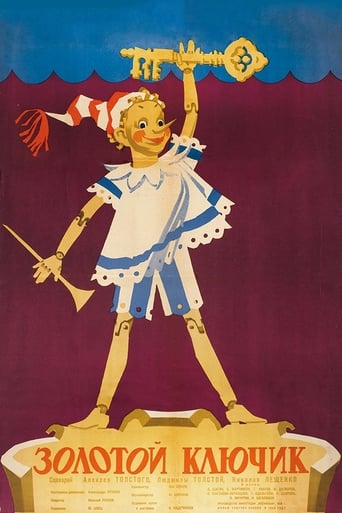
The Golden Key (1939)
Золотой ключик
A film combining live action and stop-motion animation about the adventures of the wooden boy Pinocchio and his friends - Pierrot, Malvina and Artemon the Poodle, about the mysterious golden key that opens the cherished door, about the good Papa Carlo and the evil Karabas-Barabas, Duremar, Basilio the Cat and Alice the Fox.
- Date of release
- 1939-12-20
- TMDB
- 5.3 / 10 (15)
- Runtime
- 1h 12m
- Genres
- Animation, Fantasy, Adventure
- Director
- Aleksandr Ptushko
Casting
- Sergei Martinson — Duremar
- Olga Shaganova-Obraztsova — Buratino
- Aleksandr Shchagin — Karabas-Barabas
- Georgiy Uvarov — Papa Carlo
- Mikhail Dagmarov — Giuseppe
- Raisa Khairova — Pierrot
- Tamara Adelheim — Malvina
- Nikolai Michurin — Sandro
- Valentina Pokorskaya — Alice
- Kirill Nikiforov — Basilio
- Nikolai Bogolyubov — Air ship captain
- S. Zonnenburg
Interesting facts
- Based on: The Golden Key, or the Adventures of Buratino
The Golden Key is a 1939 Soviet fairy-tale movie directed by Aleksandr Ptushko. It is based on the Russian tale The Golden Key, or The Adventures of Buratino by Aleksey Tolstoy, originally inspired by the story of Pinocchio written by Carlo Collodi. In 2009, Russia TV adapted both the original and its remake into a musical.
Production
In scenes featuring puppet characters, including Buratino himself, a combination of classical frame-by-frame three-dimensional animation and the method of perspective matching was used. The former was applied primarily when Buratino interacted with Shushara, Tortila, Alice, and Basilio, with all of them portrayed as puppets.
In the book "The Golden Key. Notes of Buratino," Olga Shaganova-Obraztsova said that she did not portray a doll but became one herself. The audience did not realize that it was a living person. To achieve this, several measures were taken. First and foremost, the proportions had to be altered. A mask, or rather, an entire head made of papier-mâché, was placed on the actress.
Tights painted to resemble wood were worn on her arms and legs, and black velvet joints were affixed to her knees and elbows. Enormous shoes and cardboard gloves were fitted onto her hands and feet.
Initially, it seemed physically impossible to move in this attire. Olga struggled to see through the mask's slits, frequently bumping into objects. The wooden corset's edges cut painfully, and the long shoes hindered her movement. Overcoming these challenges was crucial to convincingly embodying the mischievous, cheerful, wooden Buratino in both appearance and behavior.
During the initial test shots, Shaganova-Obraztsova barely recognized herself as she moved like a small doll while the objects appeared normal in size. Another complication emerged when Buratino had to interact with living characters like Papa Carlo and Karabas-Barabas, who were meant to appear larger. Optical alignment techniques were employed to address this issue, thanks to director Ptushko.
Read on Wikipedia · Text from Wikipedia, CC BY-SA 4.0. Data from Wikidata.
Recommended
- The Humpbacked Horse 1975 · ★ 6.4
- Welcome to Smelliville 2021 · ★ 6.7
- A Tooth Fairy Tale 2025 · ★ 8.5
- The Monkey King 2023 · ★ 6.5
- The Pagemaster 1994 · ★ 6.4
- The Big Trip 2019 · ★ 6.8
- Pets United 2019 · ★ 5.9
- Arctic Dogs 2019 · ★ 6.0
- Dolphin Boy 2022 · ★ 6.3
- Return to Never Land 2002 · ★ 6.5
- Curious George 3: Back to the Jungle 2015 · ★ 6.7
- Chickenhare and the Hamster of Darkness 2022 · ★ 7.2