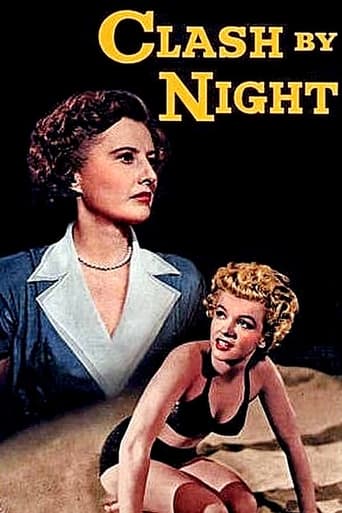
Clash by Night (1952)
Livin’ in my house! Lovin’ another man! Is that what you call bein’ honest? That’s just givin’ it a nice name!
An embittered woman seeks escape in marriage, only to fall for her husband’s best friend.
- Date of release
- 1952-05-30
- TMDB
- 6.7 / 10 (143)
- Runtime
- 1h 45m
- Genres
- Drama, Romance
- Director
- Fritz Lang
Casting
- Barbara Stanwyck — Mae Doyle D'Amato
- Paul Douglas — Jerry D'Amato
- Robert Ryan — Earl Pfeiffer
- Marilyn Monroe — Peggy
- J. Carrol Naish — Uncle Vince
- Keith Andes — Joe Doyle
- Silvio Minciotti — Papa D'Amato
- Tony Martin — Singer of 'I Hear a Rhapsody' (voice) (uncredited)
- William Bailey — Waiter (uncredited)
- Harry Baum — Restaurant Patron (uncredited)
- Dan Bernaducci — Guest (uncredited)
- Albert Cavens — Restaurant Patron (uncredited)
Interesting facts
Clash by Night is a 1952 American film noir directed by Fritz Lang and starring Barbara Stanwyck, Paul Douglas, Robert Ryan, Marilyn Monroe and Keith Andes. The film is based on the 1941 play by Clifford Odets and was adapted for the screen by writer Alfred Hayes.
Production
Clifford Odets' play Clash by Night was originally performed in 1941 as a neorealist Broadway play with Tallulah Bankhead in the lead female role. Robert Ryan, who eventually starred in the film version, was a member of the Broadway cast along with Bankhead at the start of his career.
Joan Crawford was originally scheduled to play the female lead, and her contract was to award her five percent of the film's gross, an unprecedented figure. However, Crawford was forced to withdraw because of her commitments to This Woman Is Dangerous and Sudden Fear. Barbara Stanwyck was announced in August 1951.
Ryan was cast in December 1950 after renewing a contract with RKO Radio Pictures, but in an unspecified role. Burt Lancaster was rumored to be Crawford's costar, and the producers also sought Richard Carlson, Marlon Brando, Montgomery Clift and Charlton Heston. The search for the male lead caused a delay in production.
Fritz Lang was announced as the director in August 1951. Lang changed the locale from Staten Island to a fishing town in California but preserved the oppressive seacoast atmosphere. However, to satisfy the demands of the Production Code, the tragic ending of the play was changed. Production began on October 8, 1951 with location filming in Monterey, California.
The title of the film, as well as that of the play, is derived from Matthew Arnold's 1851 poem "Dover Beach".
Read on Wikipedia · Text from Wikipedia, CC BY-SA 4.0. Data from Wikidata.
Recommended
- Nine Lives 2005 · ★ 6.1
- Newness 2017 · ★ 6.1
- A Journal for Jordan 2021 · ★ 6.9
- Petulia 1968 · ★ 6.0
- Fire with Fire 1986 · ★ 6.2
- Afterglow 1997 · ★ 5.9
- Twin Falls Idaho 1999 · ★ 6.9
- The Golden Bowl 2000 · ★ 6.0
- Heatwave 2022 · ★ 6.2
- Two for the Seesaw 1962 · ★ 6.5
- Blind 2017 · ★ 6.1
- Elena Undone 2010 · ★ 6.9