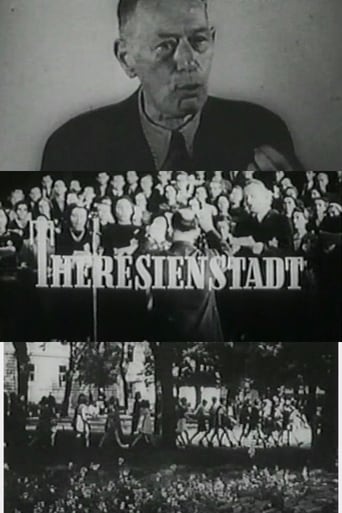
Theresienstadt (1944)
Nazi propaganda film about the Czech "Theresienstadt ghetto" in Terezín. The film was supposed to show the world that Jews didn't suffer in concentration camps. Upon completion, most Jews shown in the film (including director Kurt Gerron) were brought to Auschwitz, where they were killed.
- Data de estreia
- 1944-01-01
- TMDB
- 3.1 / 10 (8)
- Duração
- 23 min
- Géneros
- Documentário
- Realizador
- Kurt Gerron, Karel Pečený
Elenco
- Paul Eppstein — Vorsitzender des Ältestenrates der Juden / Soziologe - Mannheim - Berlin
- Karel Fischer — Dirigent
- Kurt Gerron — Regisseur - Schauspieler
- Frau Görtz — Gräfin - Holland
- Adolf Hitler — Self (archive footage)
- Hans Krása — Komponist - Prag
- Alfred Meissner — Jurist - ehem. Minister - Tschechoslowakei
- Benjamin Murmelstein — Self
- Coco Schumann — Self
- Jo Spier — Maler - Zeichner - Holland
Curiosidades
Theresienstadt. Ein Dokumentarfilm aus dem jüdischen Siedlungsgebiet, unofficially Der Führer schenkt den Juden eine Stadt, is a black-and-white projected Nazi propaganda film. It was directed by the German Jewish prisoner Kurt Gerron and the Czech filmmaker Karel Pečený under close SS supervision in the Theresienstadt concentration camp, and edited by Pečený's company, Aktualita. Filmed mostly in the autumn of 1944, it was completed on 28 March 1945 and screened privately four times. After the war, the film was lost but about twenty minutes of footage was later rediscovered in various archives.
Filming
Preparations for a second Theresienstadt film, again sponsored by Günther rather than Goebbels, began concurrently with the "beautification" of the ghetto prior to the Red Cross visit. Günther's Central Office, which was funded by stolen Jewish property, paid a Czech company, Aktualita, 350,000 Czech koruna (35,000 Reichsmarks) to produce the film.
Kurt Gerron, a leading German Jewish actor and director, had fled to the Netherlands and was deported from Westerbork to Theresienstadt in February 1944. In July, the film project was revived and Gerron was ordered to write a script, which was used in the film. While the script has traditionally been credited to Gerron, it closely adhered to Weil's draft and the dictates of the SS; his creative role was minimal.
Filming took place over eleven days between 16 August and 11 September 1944. The assistant directors were František Zelenka, Jo Spier, and Hans Hofer. Karel Pečený and his company Aktualita provided the cameramen, and halfway through filming, Pečený effectively took over as director. The two cameramen were Ivan Frič and Čeněk Zahradníček, assisted by Benda Rosenwein. The film's soundtrack has been credited to Jaroslav Sechura and Josef Francek.
On 28 October, Gerron was deported to Auschwitz, where he was murdered, never seeing even a preliminary version of the film. The film was cut by Ivan Frič, who did not use Gerron's proposals for cutting or any of the scripts, but instead using the same improvised technique that he used for Aktualita's weekly newsreels. Frič had to cut the ending three times before Günther accepted it.
Ler na Wikipédia · Texto da Wikipédia, CC BY-SA 4.0. Dados do Wikidata.
Recomendados
- Making "The Matrix" 1999 · ★ 7.5
- Drew: The Man Behind the Poster 2013 · ★ 7.0
- Fuck 2006 · ★ 6.4
- Birth of the Living Dead 2013 · ★ 6.7
- The Class of ‘92 2013 · ★ 7.1
- As I Was Moving Ahead Occasionally I Saw Brief Glimpses of Beauty 2000 · ★ 7.8
- Directed by John Ford 1971 · ★ 7.0
- Jim: The James Foley Story 2016 · ★ 7.2
- A Noite Cairá 2014 · ★ 7.6
- S4: The Bob Lazar Story 2026 · ★ 8.4
- Deliver Us from Evil 2006 · ★ 7.2
- Naqoyqatsi - Vida em Guerra 2002 · ★ 6.2