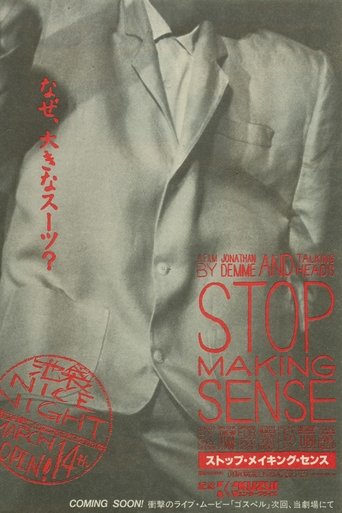
ストップ・メイキング・センス (1984)
Stop Making Sense
なぜ、大きなスーツ?
ロックバンド、トーキング・ヘッズのライブドキュメンタリー。1983年にバンデージ・シアターで行ったステージを様々なカメラワークで捉え、生の熱気をストレートに伝える。
キャスト
- デヴィッド・バーン — Self - Vocals, Guitar
- Chris Frantz — Self - Drums, Vocals
- Jerry Harrison — Self - Guitar, Keyboards, Vocals
- Tina Weymouth — Self - Bass, Percussion, Vocals
- Ednah Holt — Self - Backing Vocals
- Lynn Mabry — Self - Backing Vocals
- Steven Scales — Self - Percussion
- Alex Weir — Self - Guitar, Vocals
- Bernie Worrell — Self - Keyboards
豆知識
- 製作費:$120万
- 撮影地:RKOパンテージズ・シアター
- 受賞:1 · ノミネート:2. 主な受賞:全米映画批評家協会賞 ノンフィクション作品賞
Stop Making Sense is a 1984 American concert film featuring a live performance by the American rock band Talking Heads. The film was directed by Jonathan Demme, produced by Gary Goetzman, and executive produced by Gary Kurfirst, the band’s longtime manager. The film was shot over four nights in December 1983 at Hollywood's Pantages Theatre while Talking Heads were on tour promoting their fifth studio album, Speaking in Tongues (1983). Stop Making Sense includes performances of the early Talking Heads single "Psycho Killer" (1977), through to their most recent hit at the time, "Burning Down the House" (1983).
Production
The filming of Stop Making Sense spanned four live shows at the Pantages Theatre in Los Angeles between December 13 and 16, 1983. Initially, three nights were booked but a fourth night, December 16, was added for additional filming. Although the film was originally recorded using analog techniques, it was later transferred and then digitally edited and mixed using a Sony PCM-3324 24-track digital recorder.
Demme also considered including more shots of the audience reacting to the performance, as is traditional in concert films. However, he discovered that filming the audience required additional lighting, which inhibited the audience's energy. This in turn made the band feel insecure and thus led to "the worst Talking Heads performance in the history of the band's career".
The big suit that Byrne wears during "Girlfriend is Better" was partly inspired by Noh theatre styles and became an icon not only of the film – as it appears on the movie poster, for instance – but of Byrne himself. Byrne said: "I was in Japan in between tours and I was checking out traditional Japanese theater – Kabuki, Noh, Bunraku – and I was wondering what to wear on our upcoming tour.
The film was conceived with the intention of only filming the concert, with no plans for cutaways to interviews with the band members, or the use of split-screen. The band reflected this was a wise choice in hindsight: the mockumentary This Is Spinal Tap was released in the same year, with Weymouth remarking the film would have inevitably been compared to Spinal Tap had they taken that approach.
The film's title was derived from a lyric in the song "Girlfriend Is Better".
Wikipediaで続きを読む · テキストはWikipedia、CC BY-SA 4.0。データはWikidata。
おすすめ
- Led Zeppelin: Celebration Day 2012 · ★ 8.2
- Gimme Shelter 1970 · ★ 7.4
- Justin Bieber's Believe 2013 · ★ 6.9
- ワン・ダイレクション THIS IS US 2013 · ★ 8.2
- Dua Lipa: Studio 2054 2020 · ★ 9.0
- ビリー・アイリッシュ - HIT ME HARD AND SOFT : THE TOUR 2026 · ★ 8.5
- Depeche Mode: 101 1989 · ★ 8.0
- Nirvana: Live! Tonight! Sold Out!! 1994 · ★ 7.5
- オアシス:ドント・ルック・バック・イン・アンガー 2026 · ★ 7.0
- Roger Waters: The Wall 2014 · ★ 8.0
- Iron Maiden: Burning Ambition 2026 · ★ 8.5
- Pink Floyd: Live at Pompeii 1972 · ★ 8.1