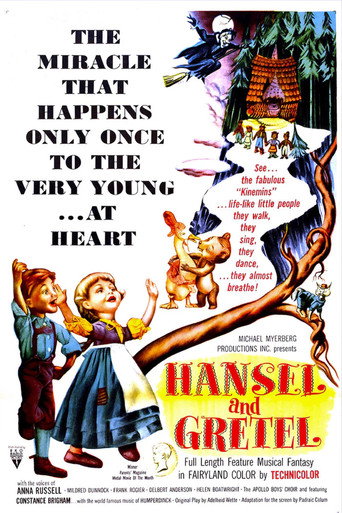
Hansel and Gretel: An Opera Fantasy (1954)
An "electronic puppet" version of the Humperdinck opera, adapted for children and using spoken dialogue as well as Humperdinck's music.
- Data lansării
- 1954-10-09
- TMDB
- 6.3 / 10 (4)
- Durată
- 1 h 12 min
- Genuri
- Animaţie, Muzică, Familie, Fantasy
- Regizor
- John Paul
Distribuție
- Anna Russell — Rosina Rubylips, the Witch
- Mildred Dunnock — Mother
- Frank Rogier — Father
- Delbert Anderson — Sandman
- Helen Boatwright — Dew Fairy
- Constance Brigham — Hansel / Gretel
Curiozități
Hansel and Gretel is a 1954 stop-motion animated theatrical feature film released by RKO Radio Pictures.
Production
The film is based on Engelbert Humperdinck's opera Hänsel und Gretel, from which its music derives. It was the first American feature-length animated film not made by Disney since 1941's Mr. Bug Goes to Town and the first American feature-length animated film not made with traditional animation, and first RKO distributed animated film not produced by Disney.
In 1952, Evalds Dajevskis began working for Myerberg Productions to conceptualize the look of the film and design the miniature sets. Dajevskis built the sets out of thick papier-mâché, appliqued paper cutouts and painted backings. The witch's gingerbread house, the Hall of the Angels, and Hansel and Gretel's home were all constructed with trap doors underneath.
The film was shot in Myerberg's studio in New York. The puppets used in the film were called "kinemins." The bodies of the kinemins were sculpted in clay by James Summers and cast in foam latex by George Butler. Summers also painted the figures. The puppets were built to one-third scale and cost $2,500 each to build.
The witch character was renamed Rosina Rubylips. This differs from the original opera in which the witch tells Hansel that her name is Rosine Leckermaul (translated as Rosina Tastymuzzle).
The mother and father figures were sculpted to resemble Mildred Dunnock (Death of a Salesman) and Frank Rogier, who supplied their voices.
Citește pe Wikipedia · Text din Wikipedia, CC BY-SA 4.0. Date din Wikidata.
Recomandate
- Frumoasa și Bestia: A 30-a aniversare 2022 · ★ 6.8
- Legends of Oz: Dorothy's Return 2014 · ★ 6.2
- Magie ciudată 2015 · ★ 7.3
- Mătura Vrăjitoarei 2012 · ★ 6.7
- Make Mine Music 1946 · ★ 5.8
- Gușă-roșie Robin 2021 · ★ 7.0
- ParaNorman 2012 · ★ 7.1
- Fantasia 1940 · ★ 7.4
- Revolting Rhymes 2017 · ★ 6.8
- Melody Time 1948 · ★ 6.1
- Clopoțica 2008 · ★ 7.0
- Barbie: Aventura prințesei 2020 · ★ 6.9