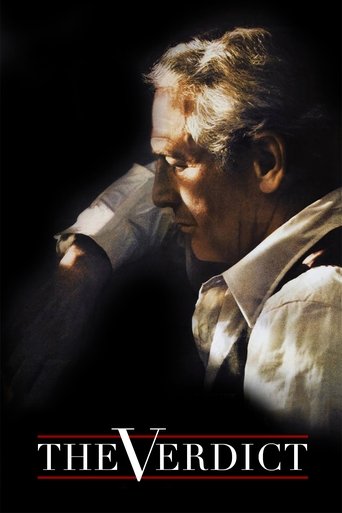
The Verdict (1982)
Frank Galvin has one last chance to do something right.
Frank Galvin is a down-on-his-luck lawyer and reduced to drinking and ambulance chasing, when a former associate reminds him of his obligations in a medical malpractice suit by serving it to Galvin on a silver platter—all parties are willing to settle out of court. Blundering his way through the preliminaries, Galvin suddenly realizes that the case should actually go to court—to punish the guilty, to get a decent settlement for his clients... and to restore his standing as a lawyer.
- Date of release
- 1982-12-08
- TMDB
- 7.5 / 10 (787)
- Runtime
- 2h 9m
- Genres
- Drama
- Director
- Sidney Lumet
Casting
- Paul Newman — Frank Galvin
- Charlotte Rampling — Laura Fischer
- Jack Warden — Mickey Morrissey
- James Mason — Ed Concannon
- Milo O'Shea — Judge Hoyle
- Lindsay Crouse — Kaitlin Costello
- Edward Binns — Bishop Brophy
- Julie Bovasso — Maureen Rooney
- Roxanne Hart — Sally Doneghy
- James Handy — Kevin Doneghy
- Wesley Addy — Dr. Towler
- Joe Seneca — Dr. Thompson
Interesting facts
- Box office: $54M
- Budget: $16M
- Earned 3.4× its budget
- Filmed in: Toronto
- Awards: 1 · Nominations: 5. Including: National Board of Review: Top Ten Films
The Verdict is a 1982 American legal drama film directed by Sidney Lumet and written by David Mamet, adapted from Barry Reed's 1980 novel of the same name. The film stars Paul Newman as a down-on-his-luck alcoholic lawyer in Boston who accepts a medical malpractice case, initially to make money and improve his own tenuous situation, but he discovers while working the case that he is doing the right thing and serving justice. Charlotte Rampling, Jack Warden, James Mason, Milo O'Shea and Lindsay Crouse appear in supporting roles.
Production
Film rights to Reed's novel were bought by the team of Richard Zanuck and David Brown. A number of actors, including Roy Scheider, William Holden, Frank Sinatra, Cary Grant and Dustin Hoffman, expressed interest in the project because of the strength of the lead role. Arthur Hiller was attached to direct while David Mamet was hired to write a screenplay.
Though Mamet had made a name for himself in the theater, he was still new to screenwriting, with his first screenplay credit occurring recently in The Postman Always Rings Twice (1981). The producers were uncertain whether Mamet would take the job in light of the standards he set with his previous playwrighting, but according to Lindsay Crouse, who was then married to Mamet, the film project was actually a big deal for him.
In Mamet's original adaptation, the film ended after the jury left the courtroom for deliberations, giving no resolution to the Deborah Ann Kaye case. Zanuck and Brown did not believe they could make the film without showing what happened in the trial, and Zanuck met with Mamet to convince him to rewrite the ending. Mamet replied that Zanuck's notion of an ending was "old-fashioned" and would hurt the film.
The producers commissioned another screenplay from Jay Presson Allen, which they preferred, and they were approached by Robert Redford who wanted to star in the film after he obtained a copy of Allen's script. Redford recommended James Bridges as the film's writer-director, and he had Bridges create successive screenplay drafts, each one further sanitizing the lead character as Redford was concerned about playing a hard-drinking womanizer.
Next, Zanuck and Brown contacted Sidney Lumet to direct, sending him the Bridges and Allen screenplays. After reading the various drafts, Lumet decided the story's grit was fast devolving and he told the producers he would do the film, but that he chose Mamet's original script (they did not know he was aware of its existence). In Lumet's opinion, the rewrites were getting worse because Redford "was slowly shifting the emphasis on the character.
Read on Wikipedia · Text from Wikipedia, CC BY-SA 4.0. Data from Wikidata.
Recommended
- The Rainmaker 1997 · ★ 7.0
- Changing Lanes 2002 · ★ 6.3
- Juror #2 2024 · ★ 6.9
- Awakenings 1990 · ★ 7.8
- Philadelphia 1993 · ★ 7.7
- Just Mercy 2019 · ★ 7.8
- If I Stay 2014 · ★ 7.3
- The Children Act 2018 · ★ 6.6
- Roman J. Israel, Esq. 2017 · ★ 6.3
- Breakthrough 2019 · ★ 7.6
- Good Will Hunting 1997 · ★ 8.2
- The Judge 2014 · ★ 7.3