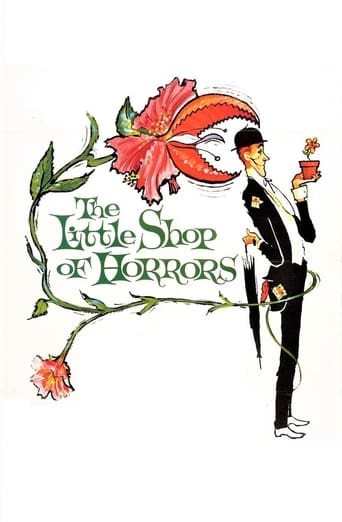
The Little Shop of Horrors (1960)
The funniest picture this year!
Seymour works in a skid row florist shop and is in love with his beautiful co-worker, Audrey. He creates a new plant that not only talks but cannot survive without human flesh and blood.
- Date of release
- 1960-05-04
- TMDB
- 6.2 / 10 (493)
- Runtime
- 1h 13m
- Genres
- Horror, Comedy, Fantasy
- Director
- Roger Corman
Casting
- Jonathan Haze — Seymour Krelboined
- Jackie Joseph — Audrey Fulquard
- Mel Welles — Gravis Mushnick
- Dick Miller — Burson Fouch
- Myrtle Vail — Winifred Krelboined
- Karyn Kupcinet — Shirley
- Toby Michaels — Teenage Girl
- Leola Wendorff — Siddie Shiva
- Lynn Storey — Hortense Feuchtwanger
- Wally Campo — Joe Fink
- Jack Warford — Frank Stoolie
- Meri Welles — Leonora Clyde
Interesting facts
- Budget: $30K
The Little Shop of Horrors is a 1960 American comedy horror film directed and produced by Roger Corman, from a screenplay by Charles B. Griffith. The film is a farce about a florist's assistant who cultivates a plant that feeds on human blood. It stars Jonathan Haze, Jackie Joseph, Mel Welles, and Dick Miller, who had all worked for Corman on previous films. Produced under the title The Passionate People Eater, the film employs an original style of humor, combining dark comedy with farce and incorporating Jewish humor and elements of spoof. The Little Shop of Horrors was shot on a budget of $28,000.
Production
The film was partially cast with stock actors that Corman had used in previous films. Writer Charles B. Griffith portrays several small roles. Griffith's father appears as a dental patient, and his grandmother, Myrtle Vail, appears as Seymour's hypochondriac mother. Dick Miller, who had starred as the protagonist of A Bucket of Blood, was offered the role of Seymour, but turned it down, instead taking the smaller role of Burson Fouch.
It had been rumored that the film's shooting schedule was based on a bet that Corman could not complete a film within that time. However, this claim has been denied by Mel Welles. According to Joseph, Corman shot the film quickly in order to beat changing industry rules that would have prevented producers from "buying out" an actor's performance in perpetuity.
Interiors were shot with three cameras in wide, lingering master shots in single takes. Welles states that Corman "had two camera crews on the set—that's why the picture, from a cinematic standpoint, is really not very well done. The two camera crews were pointed in opposite directions so that we got both angles, and then other shots were 'picked up' to use in between, to make it flow.
At the time of shooting, Jack Nicholson had appeared in two films and worked with Roger Corman as the lead in The Cry Baby Killer. According to Nicholson, "I went in to the shoot knowing I had to be very quirky because Roger originally hadn't wanted me. In other words, I couldn't play it straight.
According to Nicholson, "we never did shoot the end of the scene. This movie was pre-lit. You'd go in, plug in the lights, roll the camera, and shoot. We did the take outside the office and went inside the office, plugged in, lit and rolled. Jonathan Haze was up on my chest pulling my teeth out. And in the take, he leaned back and hit the rented dental machinery with the back of his leg and it started to tip over. Roger didn't even call cut.
Read on Wikipedia · Text from Wikipedia, CC BY-SA 4.0. Data from Wikidata.
Recommended
- Little Shop of Horrors 1986 · ★ 7.0
- Death Becomes Her 1992 · ★ 6.8
- The Abominable Dr. Phibes 1971 · ★ 6.9
- Tales of Terror 1962 · ★ 6.7
- The Addams Family 1991 · ★ 7.1
- Wendell & Wild 2022 · ★ 6.6
- R.L. Stine's Monsterville: The Cabinet of Souls 2015 · ★ 6.6
- Gremlins 1984 · ★ 7.1
- Eddie: The Sleepwalking Cannibal 2012 · ★ 5.9
- The Warriors Gate 2016 · ★ 6.6
- The 'Burbs 1989 · ★ 6.8
- The Curse of Bridge Hollow 2022 · ★ 6.6