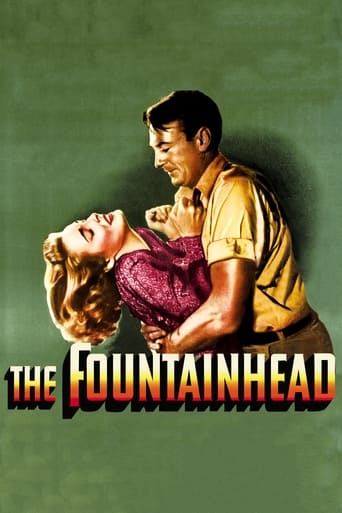
The Fountainhead (1949)
No Man Takes What's Mine!
An uncompromising, visionary architect struggles to maintain his integrity and individualism despite personal, professional and economic pressures to conform to popular standards.
- Date of release
- 1949-06-25
- TMDB
- 6.8 / 10 (168)
- Runtime
- 1h 52m
- Genres
- Drama, Romance
- Director
- King Vidor
Casting
- Gary Cooper — Howard Roark
- Patricia Neal — Dominique Francon
- Raymond Massey — Gail Wynand
- Kent Smith — Peter Keating
- Robert Douglas — Elsworth Toohey
- Henry Hull — Henry Cameron
- Ray Collins — Roger Enright
- Moroni Olsen — Chairman
- Jerome Cowan — Alvah Scarret
- Bob Alden — Newsboy (uncredited)
- John Alvin — Young Intellectual (uncredited)
- Morris Ankrum — Prosecutor (uncredited)
Interesting facts
- Budget: $2.4M
- Based on: The Fountainhead
The Fountainhead is a 1949 American black-and-white drama film produced by Henry Blanke, directed by King Vidor, and starring Gary Cooper, Patricia Neal, Raymond Massey, Robert Douglas and Kent Smith. The film is based on the bestselling 1943 novel of the same name by Ayn Rand, who also wrote the adaptation. Although Rand's screenplay was used with minimal alterations, she later criticized the editing, production design and acting.
Production
Ayn Rand's novel The Fountainhead was published in May 1943. Barbara Stanwyck read it and wanted to play the novel's heroine, Dominique Francon, in a movie adaptation. She asked Jack L. Warner to buy the rights to the book for her. Warner Bros. Pictures purchased the film rights in October 1943 and asked Rand to write the screenplay. Rand agreed, on the condition that not a single word of her dialogue be changed.
Three years later, production commenced under the direction of King Vidor, although there were disputes among Rand, Vidor, and Warner Bros. throughout the production. Vidor wanted Humphrey Bogart to play Howard Roark, and Rand wanted Gary Cooper to play the part. Stanwyck continued to push for the role of Dominique, appealing personally to Rand and to producer Henry Blanke, but Vidor thought she was too old.
Rand completed her screenplay in June 1944. The setting of The Fountainhead is a collective society in which individuals and new ideas of architecture are not accepted, and all buildings must be constructed "... like Greek temples, Gothic cathedrals and mongrels of every ancient style they could borrow", in the deathbed words of Roark's patron Henry Cameron.
While communism is not explicitly named, the film is interpreted as a criticism of the communist ideology and the lack of individual identity in a collective life under a communist society. However, the novel's criticisms were aimed at Franklin D. Roosevelt's New Deal, which is reflected in Rand's endorsement of modernism in architecture in both the book and the film.
Patricia Neal remembered that Rand often visited the set to "protect her screenplay". During filming, Vidor decided that Roark's speech at the end of the film was too long, and decided to omit segments that he did not feel relevant to the plot. After learning of Vidor's decision, Rand appealed to Jack L. Warner to honor her contract, and Warner persuaded Vidor to shoot the scene as she had written it.
Read on Wikipedia · Text from Wikipedia, CC BY-SA 4.0. Data from Wikidata.
Recommended
- The Secret: Dare to Dream 2020 · ★ 7.4
- The Sound of Silence 2019 · ★ 5.9
- Falling in Love 1984 · ★ 6.6
- The Namesake 2007 · ★ 6.8
- Rebel in the Rye 2017 · ★ 6.6
- The Age of Innocence 1993 · ★ 7.0
- I'm in Love with a Church Girl 2013 · ★ 5.9
- Genius 2016 · ★ 6.5
- The Walk 2015 · ★ 7.0
- Passing 2021 · ★ 6.3
- The House of Mirth 2000 · ★ 6.2
- The Crowd 1928 · ★ 7.6