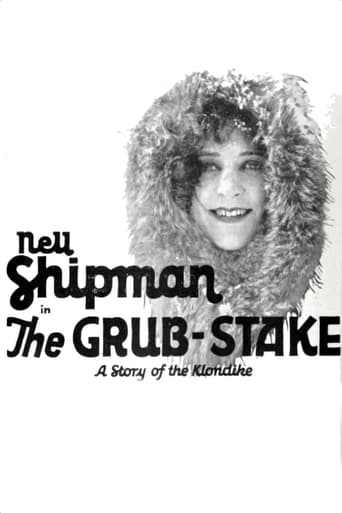
The Grub Stake (1923)
A young woman is lured to the Yukon by a gambler with promises of marriage and a grubstake for a gold mine. She takes her ailing father with her, only to discover when she gets there that the gambler was lying to her and actually planned to sell her to a dance hall. She gathers her father and an old miner she has met, takes a dogsled and supplies from the gambler and the three of them head for the wilderness to look for a lost gold claim the old miner has been looking for.
- Date of release
- 1923-02-18
- TMDB
- 6.5 / 10 (4)
- Runtime
- 1h 39m
- Genres
- Drama, Adventure, Western
- Director
- Nell Shipman, Bert Van Tuyle
Casting
- Nell Shipman — Faith Diggs
- Hugh Thompson — Jeb
- Alfred Allen — Mark Leroy
- Lillian Leighton
- George Berrell — Malamute Mike
- Walt Whitman — The Skipper
- Cecil Van Auker — The Mounty
- Ah Wing — Wong
Interesting facts
The Grub-Stake, also released as The Romance of Lost Valley and The Golden Yukon, is a 1923 American silent melodrama film co-directed by Bert Van Tuyle and Nell Shipman, who played the lead role. The screenplay was written by Shipman and produced by her company, Nell Shipman Productions. Faith Diggs, who struggles to afford medicine for her father, is lured to Alaska by Mark Leroy with the promise of employment and marriage, but Mark intends to force Faith into prostitution.
Production
Nell Shipman Productions was formed in October 1920. Nell Shipman and Bert Van Tuyle's The Girl from God's Country was a financial failure and they had to sell car and house in Highland Park, Los Angeles. On February 8, 1922, she announced her next film would be made in Spokane, Washington, on a budget of at least $110,000. Fundraising from 300 people raised US$180,000 (equivalent to $3,462,000 in 2025) for The Grub-Stake.
Van Tuyle co-directed the film with Shipman, who also wrote and edited the film and played the lead role. Shipman stated that her script for the film was outdated for the time. Lillian Leighton and Walt Whitman, who starred in The Girl from God's Country, performed in The Grub-Stake.
Joseph Walker was the cinematographer, with Robert Newhard in charge of the second camera. Filming was initially done in Spokane, at Minnehaha Studios owned by Dorothy and Wellington Playter starting on March 7, 1922. The interior scenes set in Seattle and Dawson City were shot at Minnehaha Studios. The production crew arrived for filming in Ione, Washington, on March 9, and then filmed at the Lake Pend Oreille for ten days in March.
A scene set in a dance-hall featured 300 extras on set. A storm scene in the film was shot night-for-night with two Klieg lights illuminating the area, two fire hoses used for rain, and an airplane engine for wind. The cliff-hanging scene was shot at Mount Lookout, the highest mountain in the area. No doubles were used for Shipman in the film.
The film used 22 Alaskan Malamute dogs. Shipman's zoo from Highland Park was moved to Seattle, where a $500 beaver pond was created at the studio, before being moved to Priest Lake, Idaho. Her animal collection included bears, wolves, dogs, bobcats, beavers, skunks, elk, deer, eagles, and one cougar. Brownie the Bear bit Van Tuyle's hand causing severed tendons and broken bones.
Read on Wikipedia · Text from Wikipedia, CC BY-SA 4.0. Data from Wikidata.
Recommended
- True Grit 1969 · ★ 7.3
- The Treasure of the Sierra Madre 1948 · ★ 8.0
- Forty Guns 1957 · ★ 6.6
- White Fang 1991 · ★ 6.7
- Davy Crockett and the River Pirates 1956 · ★ 6.3
- Far from Home: The Adventures of Yellow Dog 1995 · ★ 6.2
- Don't Come Knocking 2005 · ★ 6.2
- Bend of the River 1952 · ★ 7.0
- Man in the Shadow 1957 · ★ 6.7
- The Proud Rebel 1958 · ★ 6.0
- 3:10 to Yuma 1957 · ★ 7.3
- Old Yeller 1957 · ★ 6.9