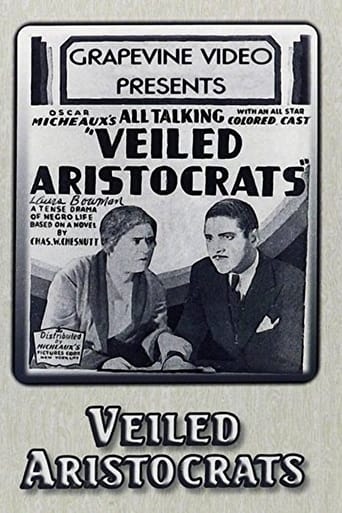
Veiled Aristocrats (1932)
A young woman plans to marry, but her mother and brother--a lawyer--don't like her prospective husband and scheme to prevent the marriage.
- Date of release
- 1932-02-01
- TMDB
- 5.4 / 10 (5)
- Runtime
- 48m
- Genres
- Drama
- Director
- Oscar Micheaux
Casting
- Lucille Lewis — Rena Walden
- Walter Fleming — John Walden
- Laura Bowman — Molly Walden
- Lawrence Chenault — Judge Straight
- Lorenzo Tucker — John Warwick
- Carl Mahon — Frank Fowler
- Barrington Guy — George Tryon
- Willor Lee Guilford — Miss Waring
- Bernardine Mason — Singer
- Aurora Edwards — Cook
- Mabel Garrett — Maid
- Arnold Wiley — Driver
Interesting facts
Veiled Aristocrats is a 1932 American pre-Code race film written, directed, produced and distributed by Oscar Micheaux. The film deals with the theme of "passing" by mixed-race African Americans to avoid racial discrimination. It is a remake of The House Behind the Cedars (1927), based on a novel by the same name published in 1900 by Charles W. Chesnutt. Micheaux may have borrowed the new title from a 1923 novel by Gertrude Sanborn.
Production
Veiled Aristocrats was Oscar Micheaux's second film adaptation of the 1900 novel The House Behind the Cedars by author Charles W. Chesnutt. In 1927 he produced it as a silent film (no print of that film is known to exist today).
In his 1932 adaptation, Micheaux altered the Chesnutt story by having Rena and Frank marry, and allowing them a happy ending. (Chesnutt's book ends with Rena's death). Micheaux's screenplay is often blunt in its exploration of color lines within the African-American community; at one point John says: "I've heard, right on the street, a coal black Negro declares he loves her!"
Micheaux shot much of Veiled Aristocrats at his mother-in-law's home in Montclair, New Jersey. Lorenzo Tucker, who played John Walden, was a popular leading man of the race film genre. He was dubbed the "black Valentino" because of his striking good looks. Laura Bowman was the leading lady in several of Micheaux's films during the 1930s, including Ten Minutes to Live (1932) and Murder in Harlem (1935).
Read on Wikipedia · Text from Wikipedia, CC BY-SA 4.0. Data from Wikidata.
Recommended
- Brotherly Love 2015 · ★ 7.0
- The Young One 1960 · ★ 7.0
- The Sound of Silence 2019 · ★ 5.9
- What Maisie Knew 2013 · ★ 7.1
- El Chicano 2019 · ★ 6.6
- The Experiment 2010 · ★ 6.4
- The Padre 2018 · ★ 5.9
- Rogue Agent 2022 · ★ 6.3
- Hardball 2001 · ★ 6.5
- Skin 2009 · ★ 6.4
- Fast Girls 2012 · ★ 6.0
- The Nest 2020 · ★ 6.1