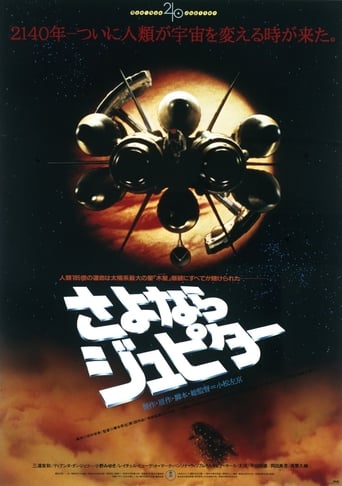
さよならジュピター (1984)
In the 22nd century, scientists from an energy-depleted Earth research new fuel sources in the far corners of the solar system, where they discover an ancient alien race from Jupiter as well as the emergence of an apocalyptically dangerous black hole. Koji Hashimoto's 1983 sci-fi adventure was conceived as a Japanese competitor to the upcoming sequel to Stanley Kubrick's classic 2001, titled 2010, and often mirrors the sequel's plot.
- Date de sortie
- 1984-03-17
- TMDB
- 5.5 / 10 (11)
- Durée
- 2 h 9 min
- Genres
- Science-Fiction, Thriller, Drame
- Réalisateur
- 小松左京, 橋本幸治
Distribution
- Tomokazu Miura — Dr. Eiji Honda
- Diane Dangely — Maria Basehart
- 小野みゆき — Anita
- Rachel Huggett — Dr. Millicent Wilem
- Paul Tagawa — Peter
- Marc Panther — Carlos
- Akihiko Hirata — Dr. Inoue Ryutarou
- 岡田眞澄 — Dr. Mohammed Mansur
- 森繁久彌 — Earth Federation President
- Kim Bass — Booker
- William Tapier
- Nobushi Takeuchi
Anecdotes
- Adapté de : Sayonara Jupiter
Bye-Bye Jupiter is a 1984 Japanese science fiction film directed by Sakyo Komatsu and Koji Hashimoto and co-produced and written by Komatsu. An early draft of the film's story was novelized by Komatsu two years prior to its release as Sayonara Jupiter, which won the 1983 Seiun Award. Akihiko Hirata made his final film appearance in the film.
Production
Star Wars was released in Japan in 1978, contributing to that country’s science fiction boom. Its contemporaries included two domestically produced films, Toho's The War in Space and Toei’s Message from Space. Prior to production on The War in Space, Toho offered a contract to author Sakyo Komatsu to write a science fiction film. Komatsu had long desired to make a film comparable to 2001 A Space Odyssey.
Simultaneously, Toho registered copyright in the United States. Toho planned a co-production US partners due to an estimated film length of three hours and the involvement of hundreds of foreign cast members.
In 1980, a novel based on the first screenplay was serialized in “The Weekly Sankei” and published in two volumes in 1982. The shooting script was completed in March 1983. Original director Shiro Moritani, who had previously worked on the Komatsu project Japan Sinks, died in December 1984. He was replaced by assistant director Koji Hashimoto.
Lire sur Wikipédia · Texte de Wikipédia, CC BY-SA 4.0. Données de Wikidata.
Recommandés
- Europa Report 2013 · ★ 6.3
- Star Trek : Insurrection 1998 · ★ 6.5
- 2073 2024 · ★ 6.7
- 2010 : L'Année du premier contact 1984 · ★ 6.7
- Space/Time 2025 · ★ 5.8
- Geostorm 2017 · ★ 6.1
- Le Passager nº4 2021 · ★ 6.0
- Spaceman 2024 · ★ 6.7
- Gravity 2013 · ★ 7.2
- Stargate : Enfants des dieux 2009 · ★ 7.2
- The X-Files : le film 1998 · ★ 6.9
- Star Trek: Nemesis 2002 · ★ 6.3