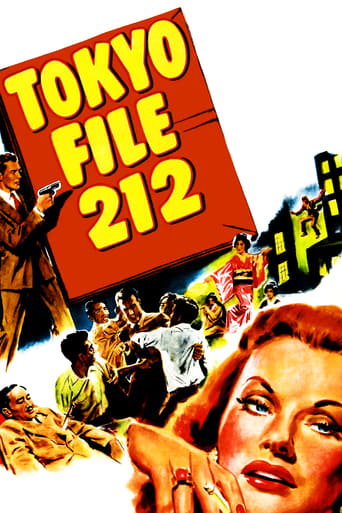
Tokyo Dossier 212 (1951)
Tokyo File 212
Un réseau d'espions communistes au Japon tente de saboter l'effort de guerre américain durant la guerre de Corée, à l'aide d'enlèvements et de meurtres. Un agent secret américain se faisant passer pour un journaliste est dépêché à Tokyo pour mettre un terme à ces activités...
- Date de sortie
- 1951-01-26
- TMDB
- 5.1 / 10 (7)
- Durée
- 1 h 24 min
- Genres
- Crime, Drame
- Réalisateur
- Dorrell McGowan, Stuart E. McGowan
Distribution
- Florence Marly — Steffi Novak
- Lee Frederick — Jim Carter
- 灰田勝彦 — Taro Matsuto
- Jun Tazaki
- ヘンリー大川
- Reiko Otani — Namiko
- 中村哲 — Mr. Oyama
- Suisei Matsui — Joe
- 横尾泥海男
- Hideto Hayafusa
- Gen Shimizu
- Tatsuo Saitō — Mr. Matsuto
Anecdotes
- Tourné à : Japon
Tokyo File 212 is a 1951 Japanese-American coproduction spy film directed by Dorrell and Stuart E. McGowan. George Breakston wrote the film's script and coproduced it with Dorrell McGowan jointly under the banner of their newly formed Breakston–McGowan Productions and the Tonichi Enterprises Company of Japan. Lawyer Melvin Belli serves as executive producer for the film and composer Albert Glasser provided the musical score.
Production
Actor-director George Paul Breakston drafted Tokyo File 212 and met Hollywood studio executives and producers with the script. Dorrell and Stewart McGowan, in addition to writing the film's screenplay, agreed to back the production and established the company Breakston–McGowan Productions, Inc. for the venture. Lawyer Melvin Belli invested $10,000 in the project and was credited as an executive producer.
Lloyd Nolan was originally cast as the male lead, although Robert Peyton ultimately played the role, his first film appearance as a lead. Newspaper reports indicated that Leif Erickson and Sessue Hayakawa were also considered for prominent roles. Florence Marly, due to star in a large-budget Mexican feature and under contract with Allied Artists, was borrowed for the film.
American actors and crew members reached Japan on July 21, 1950. Principal photography began on the same day under the working title of Danger City. The film was completed in 36 days and its final version was prepared in two months. Tokyo File 212 was Hollywood's first feature film to be shot entirely in Japan. Most of the film was shot in Tokyo, and some key scenes were shot in Atami and Enoshima. One scene was shot at Tokyo's Imperial Theater.
For a street celebration scene shot in Enoshima, the Japanese extras drank sake to make the scene authentic. The rail-strike scene took inspiration from a similar strike that had occurred in 1949, and eight trains and 200 engineers were provided for the scene. Several actors were injured while filming the scene. Communists issued threats and the Japanese cast and crew were unwilling to work unless more security was provided.
The production team had access to places where only military cars and trucks were allowed. The film was completed with a budget of approximately $700,000. Dorrel McGowan later stated that it would have cost millions if the film had been shot in the U.S. After returning from Japan, Dorell McGowan declared that the Japanese were the greatest actors in the world. He also praised the set-building techniques employed by the Japanese.
Lire sur Wikipédia · Texte de Wikipédia, CC BY-SA 4.0. Données de Wikidata.
Recommandés
- La Maison de bambou 1955 · ★ 6.2
- Le Corps de mon ennemi 1976 · ★ 6.4
- Les Patriotes 1994 · ★ 6.7
- Symphonie pour un massacre 1963 · ★ 6.7
- Du rififi à Paname 1966 · ★ 6.2
- Au cœur du mensonge 1999 · ★ 5.9
- Le Gang des Amazones 2025 · ★ 7.2
- A chaque aube je meurs 1939 · ★ 6.9
- La police fédérale enquête 1959 · ★ 6.2
- Stavisky 1974 · ★ 5.9
- Maigret voit rouge 1963 · ★ 6.4
- Maigret tend un piège 1958 · ★ 7.1