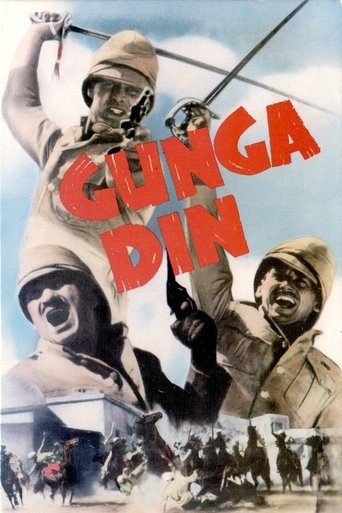
Gunga Din (1939)
Barbaric Splendor - Gasping Magnitude - Adventure !
British army sergeants Ballantine, Cutter and MacChesney serve in India during the 1880s, along with their native water-bearer, Gunga Din. While completing a dangerous telegraph-repair mission, they unearth evidence of the suppressed Thuggee cult. When Gunga Din tells the sergeants about a secret temple made of gold, the fortune-hunting Cutter is captured by the Thuggees, and it's up to his friends to rescue him.
- Date of release
- 1939-01-26
- TMDB
- 6.5 / 10 (196)
- Runtime
- 1h 57m
- Genres
- Adventure, War, Action, History
- Director
- George Stevens
Casting
- Cary Grant — Archibald Cutter
- Victor McLaglen — MacChesney
- Douglas Fairbanks Jr. — Thomas Anthony Ballantine
- Sam Jaffe — Gunga Din
- Eduardo Ciannelli — Guru
- Joan Fontaine — Emmaline "Emmy" Stebbins
- Montagu Love — Colonel Weed
- Robert Coote — Bertie Higginbotham
- Abner Biberman — Chota
- Lumsden Hare — Major Mitchell
- Leslie Sketchley — Corporal (uncredited)
- Olin Francis — Fulad (uncredited)
Interesting facts
- Box office: $2.8M
- Budget: $1.9M
- Earned 1.5× its budget
- Based on: Gunga Din
- Filmed in: California, Alabama Hills and 1 more
- Awards: 0 · Nominations: 1
Gunga Din is a 1939 American adventure film from RKO Radio Pictures directed by George Stevens and starring Cary Grant, Victor McLaglen, and Douglas Fairbanks Jr., loosely based on the 1890 poem of the same name by Rudyard Kipling combined with elements of his 1888 short story collection Soldiers Three. The film is about three British sergeants and Gunga Din, their native bhisti, who fight the Thugs, a resurgent Indian murder cult, in colonial British India.
Production
The rights to Kipling's poem were bought by producer Edward Small's Reliance Pictures in 1936 for £4,700. RKO took the rights as part of a production deal with Small when he moved to the company. William Faulkner did some preliminary script work then the project was assigned to Howard Hawks. He got Ben Hecht and Charles MacArthur to write the screenplay and the film was set to start in 1937 but was delayed to find suitable cast.
Originally, Grant and Fairbanks were assigned each other's role; Grant was to be the one leaving the army to marry Joan Fontaine's character, and Fairbanks the happy-go-lucky treasure hunter, since the character was identical to the legendary screen persona of Fairbanks' father.
According to Robert Osborne of Turner Classic Movies, when Grant wanted to switch parts, director George Stevens suggested they toss a coin; Grant won and Fairbanks Jr. lost his most important role.
On the other hand, according to a biography of director George Stevens by Marilyn Ann Moss entitled Giant: George Stevens, a Life on Film, the Cutter role was originally slated for comedy actor Jack Oakie until Grant requested the part because it would enable him to inject more humor into his performance, at which point Fairbanks Jr. was brought on board to replace Grant as Ballantine.
On a more recent showing of the film on TCM, Ben Mankiewicz has contradicted the story told about the coin-flip by his colleague Osbourne, and has stated that while Grant was originally slated to play Sergeant Ballantine, and did indeed decide to switch to the more comedic role of Sergeant Cutter, he claimed that after taking over the role that may or may not have already been filled, Grant actually recommended that his former role go to his frie…
Read on Wikipedia · Text from Wikipedia, CC BY-SA 4.0. Data from Wikidata.
Recommended
- Hornblower: The Frogs and the Lobsters 1999 · ★ 7.2
- Zulu Dawn 1979 · ★ 6.1
- Zulu 1964 · ★ 7.4
- King Arthur 2004 · ★ 6.3
- The Guns of Navarone 1961 · ★ 7.3
- To Hell and Back 1955 · ★ 6.6
- The Codes of War 2025 · ★ 6.2
- The Pride and the Passion 1957 · ★ 6.0
- The Charge of the Light Brigade 1968 · ★ 6.2
- Journey's End 2017 · ★ 6.3
- Gods and Generals 2003 · ★ 6.4
- The Last Rifleman 2023 · ★ 6.6