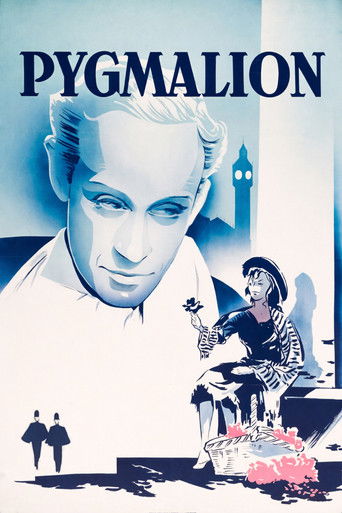
Pygmalion (1938)
He picked up a girl from the gutter - and changed her into a glamorous society butterfly!
When linguistics professor Henry Higgins boasts that he can pass off Cockney flower girl Eliza Doolittle as a princess with only six months' training, Colonel George Pickering takes him up on the bet. Eliza moves into Higgins's home and begins her rigorous training after the professor comes to a financial agreement with her dustman father, Alfred. But the plucky young woman is not the only one undergoing a transformation.
- Date of release
- 1938-10-06
- TMDB
- 7.0 / 10 (168)
- Runtime
- 1h 36m
- Genres
- Comedy, Drama, Romance
- Director
- Leslie Howard, Anthony Asquith
Casting
- Leslie Howard — Henry Higgins
- Wendy Hiller — Eliza Doolittle
- Wilfrid Lawson — Alfred Doolittle
- Marie Lohr — Mrs. Higgins
- Scott Sunderland — Colonel George Pickering
- Jean Cadell — Mrs. Pearce
- David Tree — Freddy Eynsford-Hill
- Everley Gregg — Mrs. Eynsford-Hill
- Leueen MacGrath — Clara Eynsford-Hill
- Esme Percy — Count Aristid Karpathy
- Violet Vanbrugh — Ambassadress
- Irene Browne — Duchess
Interesting facts
- Based on: Pygmalion
- Filmed in: Pinewood Studios
- Awards: 1 · Nominations: 4. Including: Academy Award for Best Writing, Adapted Screenplay
Pygmalion is a 1938 British film based on George Bernard Shaw's 1913 play, and adapted by him for the screen. It stars Leslie Howard as Professor Henry Higgins and Wendy Hiller as Eliza Doolittle.
Production
The Hungarian producer Gabriel Pascal wished to create a set of films based on Shaw's works, beginning with Pygmalion, and went to see Shaw in person to gain permission to do so. Shaw was reluctant to allow a film adaptation of Pygmalion owing to the low quality of previous film adaptations of his works, but Pascal managed to convince him (on the condition Shaw retained constant personal supervision of the adaptation) and later went on to adapt M…
The resulting Pygmalion scenario by Cecil Lewis and W. P. Lipscomb removed exposition unnecessary outside a theatrical context and added new scenes and dialogue by Shaw. Ian Dalrymple, Anatole de Grunwald and Kay Walsh also made uncredited contributions to the screenplay.
Wendy Hiller was chosen by Shaw to play Eliza Doolittle after she had appeared in stage productions of Pygmalion and Saint Joan – though the film's initial credits stated that this movie was introducing her, she had in fact already appeared on film in 1937's Lancashire Luck. Shaw's choice for Higgins had been Charles Laughton. The movie also includes the very first film appearance (brief and uncredited) of Anthony Quayle, as an Italian wigmaker.
The film's behind the camera staff included David Lean (on his first major editing job; he also directed the montage sequence of Higgins teaching Eliza), set designer Laurence Irving and the camera operator Jack Hildyard (who later photographed Lean's The Bridge on the River Kwai, The Sound Barrier and Hobson's Choice).
Read on Wikipedia · Text from Wikipedia, CC BY-SA 4.0. Data from Wikidata.
Recommended
- My Fair Lady 1964 · ★ 7.5
- Miller's Girl 2024 · ★ 6.3
- The Rewrite 2014 · ★ 6.0
- Children of a Lesser God 1986 · ★ 6.9
- The Curious Case of Benjamin Button 2008 · ★ 7.6
- Gotta Kick It Up! 2002 · ★ 6.6
- Wildflower 2023 · ★ 7.4
- French Girl 2024 · ★ 6.2
- Educating Rita 1983 · ★ 6.9
- Peggy Sue Got Married 1986 · ★ 6.1
- Smart People 2008 · ★ 5.9
- Superintelligence 2020 · ★ 5.9