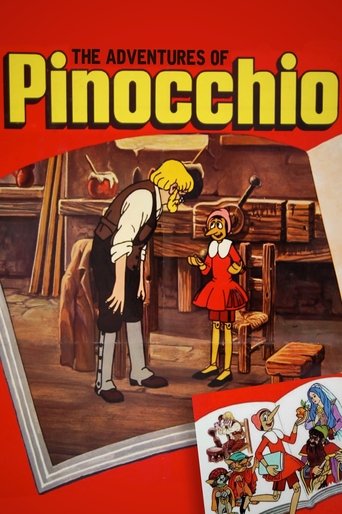
Pinocchio (1972)
Un burattino di nome Pinocchio
The film was directed by Giuliano Cenci with assistance from his brother Renzo. During production, Carlo Collodis grandchildren Mario and Antonio Lorenzini were consulted. The subtle movements made by fidgeting children whilst speaking or under scrutiny were incorporated into Pinocchios movements, particularly when he lies to the Fairy with the Turquoise Hair over the fate of his gold coins. For the design of the Fairy, Italian portrayals of the Blessed Virgin Mary in art were used as starting points.
- Date of release
- 1972-12-20
- TMDB
- 7.0 / 10 (12)
- Runtime
- 1h 33m
- Genres
- Animation, Family, Fantasy, Drama, Adventure
- Director
- Giuliano Cenci
Casting
- Roberta Paladini — Pinocchio (voice)
- Roberto Bertea — Geppetto (voice)
- Lauro Gazzolo — Grillo Parlante (voice)
- Vittoria Febbi — Fata Turchina (voice)
- Sergio Tedesco — Volpe (voice), Arlecchino (voice)
- Manlio De Angelis — Gatto (voice)
- Flaminia Jandolo — Lucignolo (voice)
- Michele Gammino — Mangiafuoco (voice)
- Arturo Dominici — Pescatore Verde (voice)
- Gianni Bonagura — Omino del carro (voice)
- Bruno Persa — Direttore del circo (voice)
- Gianfranco Bellini — Colombo (voice)
Interesting facts
- Based on: The Adventures of Pinocchio
The Adventures of Pinocchio is a 1972 Italian animated fantasy film produced by Cartoons Cinematografica Italiana. An adaptation of Carlo Collodi's 1883 book The Adventures of Pinocchio, it is written, produced, directed and edited by Giuliano Cenci. The English dub was released in the United States by G.G. Communications in October of 1978.
Production
The film was directed by Giuliano Cenci with assistance from his brother Renzo. During production, Carlo Collodi's grandchildren Mario and Antonio Lorenzini were consulted. The subtle movements made by fidgeting children whilst speaking or under scrutiny were incorporated into Pinocchio's movements, particularly when he lies to the Fairy with the Turquoise Hair over the fate of his gold coins.
For the design of Pinocchio, the animators took inspiration from illustrations made by Attilio Mussino. The backgrounds were painted by Sicilian artist Alberto D'Angelo and Abramo Scortecci who both used tone styles evocative of early 20th-century Italian art with little focus on surrealism as in the Disney adaptation.
Read on Wikipedia · Text from Wikipedia, CC BY-SA 4.0. Data from Wikidata.
Recommended
- Pinocchio 1940 · ★ 7.1
- Aladdin 1992 · ★ 6.0
- FairyTale: A True Story 1997 · ★ 6.4
- Elena and the Secret of Avalor 2016 · ★ 7.3
- Tinker Bell 2008 · ★ 7.0
- A Tooth Fairy Tale 2025 · ★ 8.5
- The Blue Bird 1940 · ★ 5.9
- Welcome to Smelliville 2021 · ★ 6.7
- Sofia the First: Once Upon a Princess 2012 · ★ 7.4
- Mia and Me: The Hero of Centopia 2022 · ★ 6.7
- Barbie Fairytopia: Mermaidia 2006 · ★ 6.9
- Happily Ever After 1989 · ★ 5.8