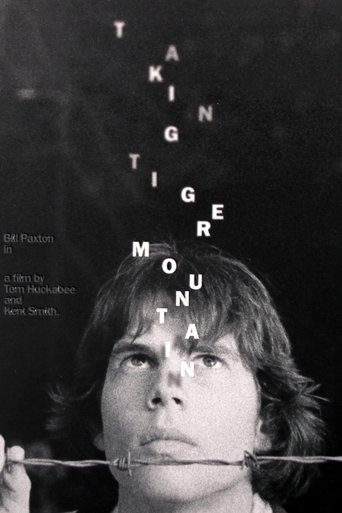
Taking Tiger Mountain (1982)
Militant feminist scientists brainwash research subject to assassinate the Welsh Minister of Prostitution. Meanwhile World War III is being fought and the USA has been invaded.
- Date of release
- 1982-09-01
- TMDB
- 4.9 / 10 (11)
- Runtime
- 1h 21m
- Genres
- Drama, Science Fiction
- Director
- Tom Huckabee, Kent Smith
Casting
- Bill Paxton — Billy Hampton
- Barry Wooller
- David Guthrie
- Mrs. Davis
- Judy Church
- Io. Church
- Cosmo Meemo Chiefo
- Barbara Clifton
- Minnie Dimple
- Ernie Dimple
- Lou Montgomery
- June Allen
Interesting facts
- Based on: Blade Runner
Taking Tiger Mountain is a 1983 American science fiction film directed by Tom Huckabee and Kent Smith, and starring Bill Paxton in one of his earliest on-screen acting roles. Originally conceived as an experimental art film inspired by Albert Camus's 1942 novel The Stranger and a poem by Smith, the film was initially directed by Smith and shot in Wales. Aside from Paxton, the film's cast is made up of townspeople from the areas in which shooting took place. It was filmed without sound, with the intention of adding dialogue in post-production.
Production
In 1973, Kent Smith wrote a poem about the kidnapping of John Paul Getty III, which was loosely adapted as the initial script for Taking Tiger Mountain. Smith also drew inspiration from the 1942 novel The Stranger by Albert Camus.
Smith, who worked as an employee at Encyclopædia Britannica Films with actor Bill Paxton, journeyed with Paxton and University of Texas at Austin student Tom Huckabee to Morocco in 1974 to begin shooting the film. They brought with them leftover film stock from the film Lenny, as well as a leased Arriflex Techniscope camera and "probably a tripod", and intended to film in the city of Tangier.
Paxton's co-stars were residents of the towns in Wales where the film was shot, rather than professional actors. The film was shot in black-and-white and without sound, with the intention of having dialogue be dubbed in later. In 1979, Huckabee leased the footage from Smith to turn it into a film. Huckabee and Paxton decided to abandon the initial idea based on the Getty kidnapping, and enlisted the help of Paul Cullum to change the script.
Read on Wikipedia · Text from Wikipedia, CC BY-SA 4.0. Data from Wikidata.
Recommended
- Jonathan 2018 · ★ 5.9
- Doctor Who: A Christmas Carol 2010 · ★ 8.0
- Doctor Who: The Runaway Bride 2006 · ★ 7.8
- Things to Come 1936 · ★ 6.4
- Waiting for Anya 2020 · ★ 6.3
- Babylon 5: The Gathering 1993 · ★ 6.5
- Babylon 5: In the Beginning 1998 · ★ 7.1
- The Last Mimzy 2007 · ★ 6.3
- A Wrinkle in Time 2003 · ★ 6.3
- WarGames 1983 · ★ 7.1
- 36 Hours 1964 · ★ 7.1
- Metropia 2009 · ★ 6.1