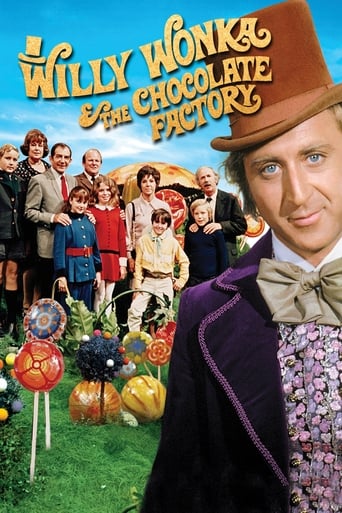
Willy Wonka & the Chocolate Factory (1971)
It's scrumdidilyumptious!
When eccentric candy man Willy Wonka promises a lifetime supply of sweets and a tour of his chocolate factory to five lucky kids, penniless Charlie Bucket seeks the golden ticket that will make him a winner.
- Date of release
- 1971-06-29
- TMDB
- 7.5 / 10 (4140)
- Runtime
- 1h 40m
- Genres
- Family, Fantasy, Comedy
- Director
- Mel Stuart
Casting
- Peter Ostrum — Charlie
- Gene Wilder — Willy Wonka
- Jack Albertson — Grandpa Joe
- Diana Sowle — Mrs. Bucket
- Julie Dawn Cole — Veruca Salt
- Roy Kinnear — Mr. Salt
- Denise Nickerson — Violet Beauregarde
- Leonard Stone — Mr. Beauregarde
- Paris Themmen — Mike Teevee
- Nora Denney — Mrs. Teevee
- Michael Böllner — Augustus Gloop
- Ursula Reit — Mrs. Gloop
Interesting facts
- Box office: $4M
- Budget: $3M
- Earned 1.3× its budget
- Based on: Charlie and the Chocolate Factory
- Filmed in: Germany
- Awards: 0 · Nominations: 1
Willy Wonka & the Chocolate Factory is a 1971 American musical fantasy film directed by Mel Stuart from a screenplay by Roald Dahl, based on Dahl's 1964 novel Charlie and the Chocolate Factory. It stars Gene Wilder as chocolatier Willy Wonka. The film tells the story of a poor child named Charlie Bucket who, upon finding a Golden Ticket in a chocolate bar, wins the chance to visit Willy Wonka's chocolate factory along with four other children from around the world.
Production
The idea for adapting the Roald Dahl book Charlie and the Chocolate Factory into a film came about when director Mel Stuart's 10-year-old daughter read the book and asked her father to make a film out of it, with "Uncle Dave" (producer David L. Wolper, who was not related to the Stuarts) producing.
Wolper and Roald Dahl agreed that Dahl would also write the screenplay. Though credited for the film, Dahl had not delivered a completed screenplay at the start of production and only gave an outline pointing to sections of the book. Wolper called in David Seltzer for an uncredited rewrite after Dahl left over creative differences.
Seltzer also created a recurring theme that had Wonka quote from various literary sources, such as Arthur O'Shaughnessy's Ode, Oscar Wilde's The Importance of Being Earnest, Samuel Taylor Coleridge's The Rime of the Ancient Mariner and William Shakespeare's The Merchant of Venice. After completing the screenplay, Seltzer was exhausted and went on vacation to a remote cabin in Maine.
Wolper decided with Stuart that the film would be a musical and approached composers Richard Rodgers and Henry Mancini but both declined. Eventually, they secured the songwriting team Leslie Bricusse and Anthony Newley.
Different explanations have been given for the title change to Willy Wonka & the Chocolate Factory. In the United States during the 1960s, the term "Mister Charlie" had been used as a pejorative expression in the African-American community for a "white man in power" (historically plantation slave owners) and press reports claimed the change was due to "pressure from black groups". During the same period, U.S.
Read on Wikipedia · Text from Wikipedia, CC BY-SA 4.0. Data from Wikidata.
Recommended
- Charlie and the Chocolate Factory 2005 · ★ 7.0
- Wonka 2023 · ★ 7.0
- Tom and Jerry: Willy Wonka & the Chocolate Factory 2017 · ★ 6.7
- Mickey's Magical Christmas: Snowed in at the House of Mouse 2001 · ★ 7.0
- Godmothered 2020 · ★ 6.7
- Sneakerella 2022 · ★ 5.9
- Tom and Jerry: A Nutcracker Tale 2007 · ★ 6.8
- A Christmas Story 1983 · ★ 7.2
- The Looney, Looney, Looney Bugs Bunny Movie 1981 · ★ 7.3
- Tom and Jerry: The Movie 1992 · ★ 6.3
- Happiness Is a Warm Blanket, Charlie Brown 2011 · ★ 7.1
- How to Eat Fried Worms 2006 · ★ 6.2