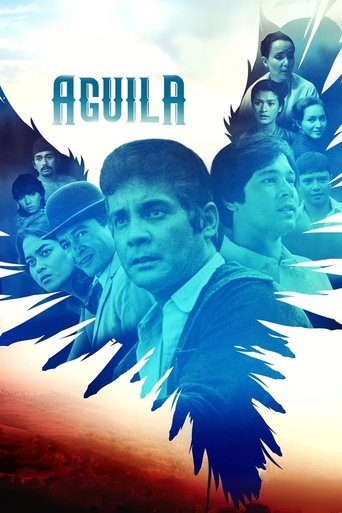
Aguila (1980)
Flashbacks encompass the history of the Philippines as well as the life story of the elderly Daniel Aguila. The Aguila family gathers to celebrate Daniel's 88th birthday, but the old man is nowhere to be seen--he has been missing for a decade. Suspecting that his father is in Mindanao, one of his sons takes off for that region in a determined search. Along the way, his memories of the nation and his father's life tell the story of 80 tumultuous years of personal and historical development.
- Date of release
- 1980-02-14
- TMDB
- 7.5 / 10 (4)
- Runtime
- 3h 30m
- Genres
- Drama, Action, Romance, War
- Director
- Eddie Romero
Casting
- Fernando Poe Jr. — Daniel
- Amalia Fuentes — Isabel
- Christopher de Leon — Mari
- Elizabeth Oropesa — Lilian
- Jay Ilagan — Osman
- Charo Santos — Sally
- Chanda Romero — Diwata
- Daria Ramirez — Elvira
- Celia Rodriguez — Margo
- Eddie Garcia — Simeon
- Orestes Ojeda — Vic
- Susan Valdez-LeGoff — Bessie
Interesting facts
Aguila (transl. Eagle) is a 1980 Philippine period drama film written, produced, and directed by Eddie Romero. Touted as "the biggest event in local movie history" and "the biggest Filipino film ever made", it features an ensemble cast topbilled by Fernando Poe Jr.
Production
The film had a budget of ₱5,000,000.00 and boasted 12 stars, 60 production staff and crewmen, and 7,000 extras.
The film was shot in 120 different locations. The film's art director, Mel Chionglo, built a Magdiwang camp and an Ilongot village on the hills of Tanay and an Aeta village in Los Baños. Chionglo had three assistants, two set men, and ten carpenters to help in this work.
The film took 100 days to shoot the 204 pages of script written for it, the latter having been written over two years.
Actress Rio Locsin was originally cast to play Huk commander Diwata but was replaced by Chanda Romero, director Eddie Romero's niece, when she failed to show up on her first shooting day.
The production was infamously marred by tensions between the crew. Among the reported incidents of tensions flaring up involved Eddie Romero's frequent butting of heads with Mel Chionglo. Romero likewise clashed with set decorator, and now screenwriter, Racquel Villavicencio over unreasonable production demands.
Read on Wikipedia · Text from Wikipedia, CC BY-SA 4.0. Data from Wikidata.
Recommended
- Mammoth 2009 · ★ 6.1
- Run 1991 · ★ 6.0
- Sahara 1983 · ★ 5.9
- The Sleeping Dictionary 2003 · ★ 6.6
- Man with No Past 2025 · ★ 6.5
- Bunraku 2010 · ★ 5.8
- The Locksmith 2023 · ★ 5.9
- Winter's Tale 2014 · ★ 6.3
- Revenge 1990 · ★ 6.5
- Damage 2009 · ★ 6.6
- A Score to Settle 2019 · ★ 5.8
- Black Site 2022 · ★ 6.0