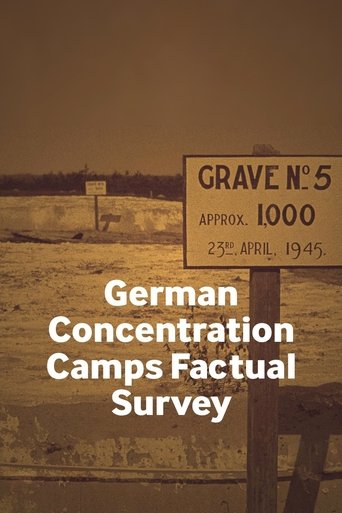
German Concentration Camps Factual Survey (2017)
On the 29th September 1945, the incomplete rough cut of a brilliant documentary about concentration camps was viewed at the MOI in London. For five months, Sidney Bernstein had led a small team – which included Stewart McAllister, Richard Crossman and Alfred Hitchcock – to complete the film from hours of shocking footage. Unfortunately, this ambitious Allied project to create a feature-length visual report that would damn the Nazi regime and shame the German people into acceptance of Allied occupation had missed its moment. Even in its incomplete form (available since 1984) the film was immensely powerful, generating an awed hush among audiences. But now, complete to six reels, this faithfully restored and definitive version produced by IWM, is being compared with Alain Resnais’ Night and Fog (1955).
- Fecha de estreno
- 2017-01-06
- TMDB
- 7.4 / 10 (19)
- Duración
- 1 h 15 min
- Géneros
- Documental, Historia, Bélica
- Director
- Sidney Bernstein
Reparto
- Jasper Britton — Narrator
- Jane Wells — Self
- David Cesarani — Self
- Anne Fleming — Self
- Adolf Hitler — Self (archive footage)
- Alfred Hitchcock — Self (archive footage)
Curiosidades
German Concentration Camps Factual Survey is the official British documentary film on the Nazi concentration camps, based on footage shot by the Allied forces in 1945.
Production history
Sidney Bernstein, a cinema entrepreneur, had been an advisor to the Ministry of Information since 1940, and from 1942 onwards had been in charge of supply of British films to cinemas in areas freed from Axis control. Early in 1945, he began to make inquiries about the availability of Soviet films showing scenes of German atrocities.
Bernstein visited the Bergen-Belsen concentration camp on 22 April 1945, a week after it was liberated by British forces. What he saw there made him determined to make the film to show to German audiences. Production of the film was ordered by the Psychological Warfare Division (PWD) which was a unit of the Supreme Headquarters Allied Expeditionary Force (SHAEF).
By the time Bernstein had visited Belsen, cameramen from the British Army Film and Photographic Unit had already been filming the early days of Belsen's liberation, including the capture of its commandant, Josef Kramer. Their films were recorded without sound.
The film eventually utilized both silent footage from combat cameramen in the armed services and sound footage from newsreel cameramen. Fourteen locations were covered by the film, including ten concentration camps and four locations where atrocities had taken place. Among the camps where footage was shot was Belsen, Dachau, Buchenwald, Auschwitz and Majdanek.
Bernstein's team included film editors Stewart McAllister, Peter Tanner, and Marcel Cohen, in addition to Crossman, Wills, and Bernstein's friend Alfred Hitchcock. Though Bernstein has described Hitchcock as the film's director, the Imperial War Museum describes Hitchcock as the film's "treatment advisor," noting that his one-month participation did not begin until after the footage was already shot and he was not involved in the rough cut of the…
Leer en Wikipedia · Texto de Wikipedia, CC BY-SA 4.0. Datos de Wikidata.
Recomendadas
- Para Sama 2019 · ★ 8.2
- I Called Him Morgan 2016 · ★ 7.0
- Z Channel: A Magnificent Obsession 2004 · ★ 7.1