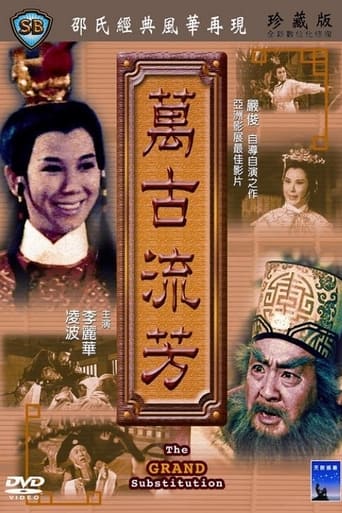
The Grand Substitution (1965)
萬古流芳
With China under control of a weak Emperor, two officials compete to steer the future destiny of the land. Chiu believes the people are the future of China, while the diabolical Tu wishes to grind the people beneath an iron heel. Tu decides to take out Chiu's family, but one lone infant escapes.
Casting
- Ivy Ling Po — Chiu Wu
- Li Li-Hua — Princess Chuan Ji
- Yan Jun — Ching Ying
- Lee Ying — Chief Warden Tu An Ko
- Ching Miao — Prime Minister Chiu Zun
- Yang Chi-Ching — Kun Zun
- Lee Ting — Po Feng
- Ha Yee-Chau — Chun Lan
- Chen Yanyan — Ching Ying's wife
- Cheung Hei — Fortune teller
- Leung Yui — Emperor Ling-Kung
- Chen Yu-Hsin — Emperor's brother Chin Kung
Interesting facts
The Orphan of Zhao is a Chinese play from the Yuan dynasty, attributed to the 13th-century dramatist Ji Junxiang (紀君祥). The play has as its full name The Great Revenge of the Orphan of Zhao. The play is classified in the zaju genre of dramas. It is divided in six parts, comprising five acts and a wedge, which may be an interlude or — as it is in this case — a prologue. It contains both dialogue and songs.
Background
Until Ji Junxiang's play in the 13th century, the story appeared in prose form as historical narrative. After Ji's play, stage drama was the main form, with numerous regional operas, some completely independent of his play.
The Records of the Grand Historian, written by the historian Sima Qian from the Han dynasty, contains a chapter surrounding the events of the Zhao family. These records were adapted by Ji Junxiang in The Orphan of Zhao. The play revolves around the theme of familial revenge, which is placed in the context of Confucian morality and social hierarchical structure.
During the Yuan dynasty, The Great Revenge of the Orphan of Zhao (趙氏孤兒大報仇), also known as The Orphan of Zhao’s Wronged Revenge (趙氏孤兒冤報冤) or simply The Orphan of Zhao, swept across the country and became one of the representative masterpieces of Yuan zaju drama.
Read on Wikipedia · Text from Wikipedia, CC BY-SA 4.0. Data from Wikidata.
Recommended
- Clika 2026 · ★ 8.3
- Coda 2020 · ★ 6.1
- Battle of the Year 2013 · ★ 6.8
- Hounddog 2008 · ★ 6.5
- Teen Spirit 2019 · ★ 6.0
- Grace Unplugged 2013 · ★ 6.0
- Mr. Turner 2014 · ★ 6.6
- Too Late Blues 1961 · ★ 6.4
- Cadillac Records 2008 · ★ 7.1
- Honey: Rise Up and Dance 2018 · ★ 6.9
- The Mambo Kings 1992 · ★ 6.4
- All Eyez on Me 2017 · ★ 6.7