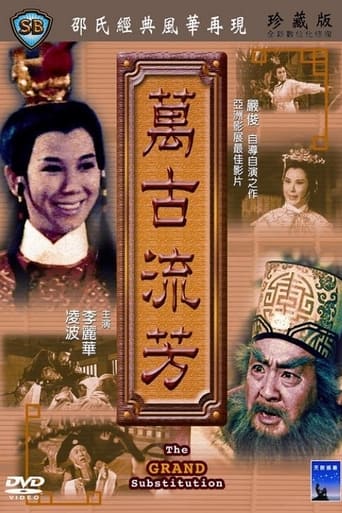
万古流芳 (1965)
萬古流芳
春秋战国时代,晋灵公宠信奸臣屠岸贾,时边关告急,相国赵盾启奏,反被屠挑拨,下令斩杀赵家三百余口。幸忠臣程婴为保忠良血脉抱赵媳庄姬之子赵武出走。屠下令杀全国男婴以断后患,程不惜以己子代春以救全国婴儿。程功成退稳,邻人感其忠烈,赠匾「万古流芳」。导演严俊演而优则导,拍出史诗式气魄。
演员阵容
- 凌波 — Chiu Wu
- 李丽华 — Princess Chuan Ji
- 严俊 — Ching Ying
- Lee Ying — Chief Warden Tu An Ko
- 井淼 — Prime Minister Chiu Zun
- 杨志卿 — Kun Zun
- 李婷 — Po Feng
- 夏仪秋 — Chun Lan
- 陈燕燕 — Ching Ying's wife
- 张照 — Fortune teller
- 梁锐 — Emperor Ling-Kung
- 陈又新 — Emperor's brother Chin Kung
趣闻
The Orphan of Zhao is a Chinese play from the Yuan dynasty, attributed to the 13th-century dramatist Ji Junxiang (紀君祥). The play has as its full name The Great Revenge of the Orphan of Zhao. The play is classified in the zaju genre of dramas. It is divided in six parts, comprising five acts and a wedge, which may be an interlude or — as it is in this case — a prologue. It contains both dialogue and songs.
Background
Until Ji Junxiang's play in the 13th century, the story appeared in prose form as historical narrative. After Ji's play, stage drama was the main form, with numerous regional operas, some completely independent of his play.
The Records of the Grand Historian, written by the historian Sima Qian from the Han dynasty, contains a chapter surrounding the events of the Zhao family. These records were adapted by Ji Junxiang in The Orphan of Zhao. The play revolves around the theme of familial revenge, which is placed in the context of Confucian morality and social hierarchical structure.
During the Yuan dynasty, The Great Revenge of the Orphan of Zhao (趙氏孤兒大報仇), also known as The Orphan of Zhao’s Wronged Revenge (趙氏孤兒冤報冤) or simply The Orphan of Zhao, swept across the country and became one of the representative masterpieces of Yuan zaju drama.
在维基百科阅读更多 · 文本来自维基百科,CC BY-SA 4.0。数据来自 Wikidata。