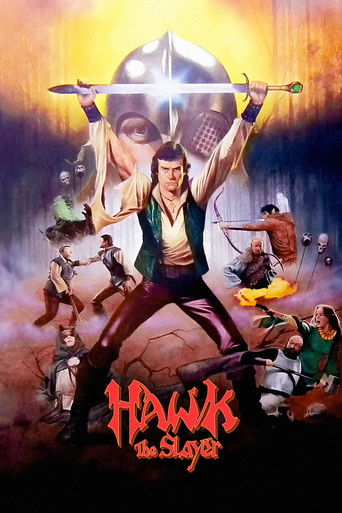
Hawk the Slayer (1980)
Beyond the edge of darkness there is a world of sword and sorcery.
Hawk the Slayer, after seeing both his father and bride die at the hands of his malevolent brother, Voltan, sets out for revenge and the chance to live up to his title. Tooling himself up with the "mind-sword" and recruiting a motley band of warriors — a giant, a dwarf, a one-armed man with a machine-crossbow, and an elf with the fastest bow in the land — Hawk leads the battle against Voltan to free the land from the forces of evil and avenge his loved ones.
- Date of release
- 1980-08-27
- TMDB
- 4.8 / 10 (70)
- Runtime
- 1h 33m
- Genres
- Fantasy, Adventure, Action
- Director
- Terry Marcel
Casting
- Jack Palance — Voltan
- John Terry — Hawk
- Bernard Bresslaw — Gort, the Giant
- Ray Charleson — Crow
- Peter O'Farrell — Baldin
- William Morgan Sheppard — Ranulf
- Patricia Quinn — Sorceress
- Cheryl Campbell — Sister Monica
- Annette Crosbie — Abbess
- Catriona MacColl — Eliane
- Shane Briant — Drogo
- Harry Andrews — High Abbot
Interesting facts
- Budget: £600K
- Filmed in: Pinewood Studios
Hawk the Slayer is a 1980 sword and sorcery adventure film directed by Terry Marcel and starring John Terry and Jack Palance. It follows Hawk and Voltan, two warring brothers. Hawk, wielding a magical sword, assembles a small force of fighters to rid the land of Voltan. The film was received negatively upon its initial release, but has since developed a cult following. Sequels were planned, but never produced.
Production
Hawk the Slayer was the brainchild of Terry Marcel and Harry Robertson. Working together, they discovered that they were both fans of sword and sorcery. They wanted to make a low-budget film to capitalize on the growing interest in the genre. Large-scale adaptations such as Thongor and Conan the Barbarian were either struggling to find backing, or undergoing budget negotiations.
Marcel has stated that the film was originally intended to be historical, and not include sorcery. However, in the course of writing the script, he added the magical mind stone to the story.
The feature was shot over the course of six weeks in Buckinghamshire (particularly within Burnham Beeches), United Kingdom.
The score is by the film’s co-writer and co-producer Harry Robertson who had previously scored several Hammer Films including Countess Dracula and Twins of Evil. It is reminiscent of Jeff Wayne's song "The Eve of the War" from the album The War of the Worlds, an extremely popular album at the time. It therefore contains a lot more electronic sounds than Robertson’s previous scores.
Read on Wikipedia · Text from Wikipedia, CC BY-SA 4.0. Data from Wikidata.
Recommended
- Warcraft 2016 · ★ 6.4
- Dragonheart: Vengeance 2021 · ★ 6.8
- Legend 1985 · ★ 6.3
- The Huntsman: Winter's War 2016 · ★ 6.3
- Ladyhawke 1985 · ★ 7.0
- The Beastmaster 1982 · ★ 6.3
- The Hobbit: The Battle of the Five Armies 2014 · ★ 7.3
- Willow 1988 · ★ 7.0
- The Lord of the Rings: The Two Towers 2002 · ★ 8.4
- The Hobbit: The Desolation of Smaug 2013 · ★ 7.6
- Crouching Tiger, Hidden Dragon: Sword of Destiny 2016 · ★ 6.2
- Abigail 2019 · ★ 6.2