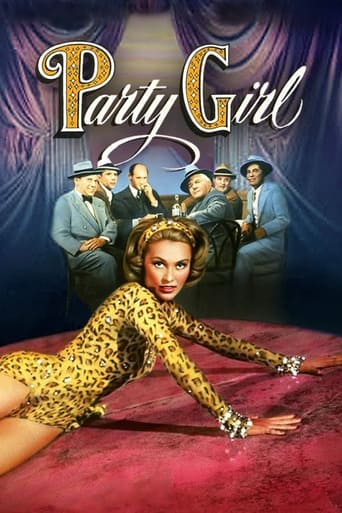
Party Girl (1958)
You'll meet her at the roughest parties ...with the toughest guys in town!
Slick lawyer Thomas Farrell has made a career of defending mobsters in trials. It's not until he meets a lovely showgirl at a mob party that he realizes that there's more to life than winning trials. Farrell tries to quit the racket, but mob boss Rico Angelo threatens to hurt the showgirl if Farrell leaves him.
- Date of release
- 1958-10-28
- TMDB
- 6.8 / 10 (70)
- Runtime
- 1h 39m
- Genres
- Crime, Drama, Romance
- Director
- Nicholas Ray
Casting
- Robert Taylor — Tommy Farrell
- Cyd Charisse — Vicki Gaye
- Lee J. Cobb — Rico Angelo
- John Ireland — Louis Canetto
- Kent Smith — Jeffrey Stewart
- Claire Kelly — Genevieve Farrell
- Corey Allen — Cookie La Motte
- Lewis Charles — Danny Rimett
- David Opatoshu — Lou Forbes
- Kem Dibbs — Joey Vulner
- Patrick McVey — Detective O'Malley
- Barbara Lang — Ginger D'Amour
Interesting facts
Party Girl is a 1958 American film noir shot in CinemaScope and Metrocolor, directed by Nicholas Ray and starring Robert Taylor, Cyd Charisse, and Lee J. Cobb. It was Charisse's final film and Taylor's next-to-last film for Metro-Goldwyn-Mayer; they were the studio's last remaining major contract stars.
Production
The song during the opening credits, "Party Girl", was written by Nicholas Brodszky (music) and Sammy Cahn (lyrics) and sung by Tony Martin, who was Cyd Charisse's husband.
Robert Taylor's character, Tom Farrell, is loosely based on Dixie Davis, who was a lawyer for mob boss Dutch Schultz and later became an informant, although film noir historian Eddie Muller claims that Louie Cuttner, a lawyer for Al Capone, was the model. Coincidentally director Nicholas Ray would end up hiring Cuttner some years later, having no idea of the connection.
According to Eddie Muller, Lee J. Cobb's character, Rico Angelo, is a "not too veiled caricature of Al Capone". The scene where Angelo beats up Frankie Gasto – played by uncredited former wrestler Aaron "Lord Spears" Saxon – was based on an incident supposedly involving Capone; it was also used by David Mamet in his screenplay for the 1987 film The Untouchables.
Making Party Girl was not a good experience for Ray. Having had problems with his last two independently produced films, and physically debilitated by the experiences, he signed to direct for MGM in order to get the security of one of the major Hollywood studios and to work again with an earlier collaborator, Charles Schnee; the two had worked together on 1948's They Live by Night, and Schnee was scheduled to be the producer of Party Girl.
Ray was barred by MGM's protocols from being involved in the direction of the musical numbers, even to the extent of discussing Charisse's character in relation to them. Ray also wanted to use period music to help recreate the era, but MGM, concerned that it would limit the film's public appeal, rejected that idea.
Read on Wikipedia · Text from Wikipedia, CC BY-SA 4.0. Data from Wikidata.
Recommended
- The Web 1947 · ★ 7.1
- Pitfall 1948 · ★ 6.8
- They Won't Believe Me 1947 · ★ 6.6
- Road House 1948 · ★ 6.7
- Witness to Murder 1954 · ★ 6.3
- They Live by Night 1949 · ★ 6.8
- The File on Thelma Jordon 1949 · ★ 6.5
- An Inspector Calls 1954 · ★ 7.2
- They Made Me a Fugitive 1947 · ★ 6.6
- Macao 1952 · ★ 6.3
- You Only Live Once 1937 · ★ 7.1
- Illegal 1955 · ★ 6.5