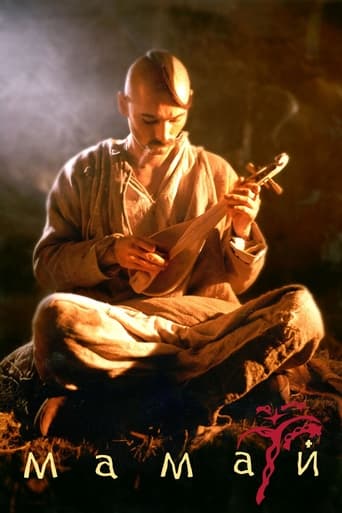
Мамай (2003)
Mamay draws on traditional Ukranian and Tatar folktales for its Romeo and Juliet-like love story and parable about chivalry and the struggle for freedom. Hundreds of years ago, in the wild steppes of Crimea that form an uneasy border between East and West, Europe and Asia, nomad and farmer, the proud Cossack Mamay falls in love with the Tatar beauty Omai. The title, like the storyline, holds a variety of different meanings taken from different cultures. In Turkic languages, it means "no one," but it was also the name of a famous Mongol conqueror, the great grandson of Ghengis-Khan. In Persian legends, mamay literally means "the spirit of the steppes. "
- Data di uscita
- 2003-02-19
- TMDB
- 6.5 / 10 (10)
- Durata
- 1 h 20 min
- Generi
- Dramma, Storia
- Regista
- Олесь Санін
Cast
- Andrii Bilous — Mamay
- Viktoria Spesivtseva — Tatar woman
- Nazl Sejtablaeva — Little Tatar girl
- Сергей Романюк — Eldest brother
- Олесь Санін — Middle brother
- Ахтем Сеітаблаєв — Tatar warrior
- Eldar Akimov — Tatar warrior
- Emil Rasilov — Tatar warrior
- Andrii Sereda
- Шевкет Сейдаметов
- Dmytro Sanin
- Сергій Марченко
Curiosità
- Premi: 1 · Candidature: 1. Tra cui: 100 best films in the history of Ukrainian cinema
Mamay is a 2003 Ukrainian language film. Based on ancient Ukrainian and Crimean Tatar folklore, it is a Ukrainian version of Romeo and Juliet. A fugitive Cossack falls in love with a stunningly beautiful Tatar woman who saves him from certain death. Their love defies age-old hatred between their respective peoples. The film features cinematography by Serhiy Mykhalchuk and a soundtrack by composer Alla Zahaikevych. It was directed by Oles Sanin. Mamay was Ukraine's 2003 submission for an Academy Award for Best Foreign Language Film.
Production costs
The film's budget amounted to 280 thousand dollars (₴10,298,738).
Leggi su Wikipedia · Testo da Wikipedia, CC BY-SA 4.0. Dati da Wikidata.
Consigliati
- Radium Girls 2020 · ★ 6.6
- La stanza di Mariana 2025 · ★ 6.8
- Oranges and Sunshine 2010 · ★ 6.9
- Le avventure di un matematico 2021 · ★ 6.1
- Monaco - Sull’orlo della guerra 2021 · ★ 6.9
- L'ombra di Stalin 2019 · ★ 6.7
- Dovbush Il Guerriero Della Montagna 2023 · ★ 7.0
- The Boy in the Woods 2023 · ★ 7.0
- Imbattibile 2006 · ★ 7.0
- Suffragette 2015 · ★ 7.2
- La ragazza nella scatola 2016 · ★ 6.7
- Belfast 2021 · ★ 7.0