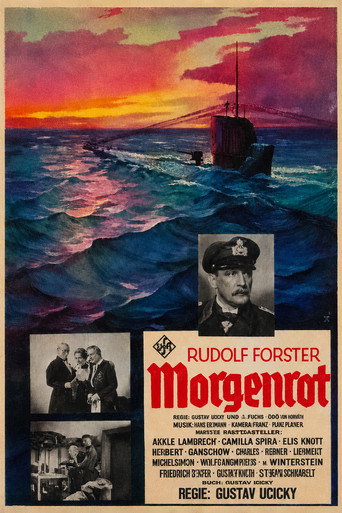
Dawn (1933)
Morgenrot
Released three days after Adolf Hitler became Reichskanzler, it was the first film to have its screening in Nazi Germany. It became a symbol of the new times touted by the Nazi regime. The title (literally "morning-red") is the German term for the reddish coloring of the east sky about a half hour before the sunrise. On patrol Captain Liers and his submarine crew sink an important British ship, but while returning to harbour, they're lured into a trap by a British vessel disguised as a neutral Danish one. They sink it after it attacks them without warning, but while they prepare to rescue survivors, a British destroyer sinks the sub. On the sea bed 60 feet down, with all but the bridge flooded, the 10 surviving crew have only 8 rescue devices. Liers orders the crew to use them, but they disobey - either all escape or nobody does.
- Date of release
- 1933-02-02
- TMDB
- 5.8 / 10 (12)
- Runtime
- 1h 25m
- Genres
- War, Drama
- Director
- Gustav Ucicky
Casting
- Rudolf Forster — Kapitanleutnant Helmut Liers
- Fritz Genschow — Oberleutnant 'Phipps' Fredericks
- Paul Westermeier — Bordfunker Jaul
- Camilla Spira — Grete Jaul
- Gerhard Bienert — Steuermann Böhm
- Adele Sandrock — Mutter Liers
- Hans Leibelt — Bürgermeister von Meerskirchen
- Eduard von Winterstein — Hauptmann Kolch
- Franz Nicklisch — Petermann
- Friedrich Gnaß — Juraczik
- Else Knott — Helga
- Frank Perfitt
Interesting facts
Morgenrot is a 1933 German submarine film set during World War I. The film was directed by Vernon Sewell and Gustav Ucicky
Production
In March 1927, the UFA studio, the largest film production company in Europe, was purchased by the media magnate Alfred Hugenberg, who wanted to own UFA to produce "national" films that glorified his right-wing politics. Morgenrot was one of the several "national" films that were released by UFA during Hugenberg's time as its owner.
The script was for Morgenrot was written by Gerhard Menzel, a successful writer from Silesia who had won the Kleist prize for the best new German play in 1927, who was also a Nazi party member. In turn, Menzel was inspired by an idea submitted by the writer Edgar von Spiegel von und zu Peckelsheim.
The film was also part of an effort to rehabilitate the reputation of the Imperial Germany Navy and of navalism in general. The November Revolution of 1918, the alleged "stab-in-the-back" that defeated Germany just as the Reich was alleged to be on the verge of victory, had started with the great High Seas Fleet mutiny.
The title of the film comes from a 19th-century poem by the Romantic writer Wilhelm Hauff whose first lines read: "Morgenrot, morgenrot/Leuchtest mir zum frühen Tod?/Bald wird die Trompete blasen/Dann muss ich Leben lassen/Ich und mancher Kamerad" ("Morning dawn, morning dawn/Do you glow to me to the early death?/Soon the trumpet will sound/Then I have to give up my life/Me and some comrades").
Read on Wikipedia · Text from Wikipedia, CC BY-SA 4.0. Data from Wikidata.
Recommended
- The One That Got Away 1957 · ★ 6.8
- The War Below 2021 · ★ 6.6
- The Fox 2023 · ★ 7.1
- Men in War 1957 · ★ 6.6
- The Scarlet and the Black 1983 · ★ 7.1
- The Beast of War 1988 · ★ 7.1
- From Hilde, with Love 2024 · ★ 7.0
- One of Our Aircraft Is Missing 1942 · ★ 6.6
- The Last Rifleman 2023 · ★ 6.6
- Walking with the Enemy 2014 · ★ 6.3
- Max 2002 · ★ 6.2
- Cast a Giant Shadow 1966 · ★ 6.3