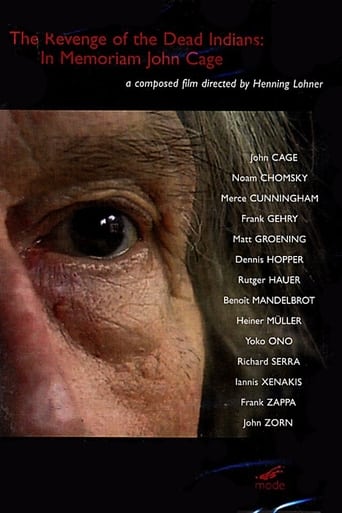
The Revenge of the Dead Indians (1993)
This is a full-length documentary honoring the life and work of American composer and artist John Cage. Cage is considered one of the most influential composers of the 20th century. This documentary features interviews with various personalities from different fields as they introduce us to the life and work of this great American artist.
- Data de estreia
- 1993-01-01
- TMDB
- 7.0 / 10 (1)
- Duração
- 2 h 9 min
- Géneros
- Documentário
- Realizador
- Henning Lohner
Elenco
- Noam Chomsky — Himself
- Matt Groening — Himself
- Frank Gehry — Himself
- Rutger Hauer — Himself
- Dennis Hopper — Himself
- Raymond Kurzweil — Himself
- Yoko Ono — Herself
- Frank Zappa — Himself
- John Zorn — Himself
Curiosidades
The Revenge of the Dead Indians is a 1993 documentary film essay directed by Henning Lohner about composer John Cage and his theories about music. It pays tribute to Cage's thoughts, music, and influence and has been described as "an unexpected and fascinating combination of intellectual thought, viewpoints and opinions."
Background and production
In the early 1990s, Lohner worked with Cage on Cage's only film production, titled One 11. Both had met in August 1990 when Cage had come to Germany to give a series of concerts. Lohner was working for German Public Television and was asked to document Cage's visit to Berlin. Subsequently, they collaborated during the final years of Cage's life.
Concert performances incorporated in the film were recorded live during the "Musicircus" homage at Symphony Space in New York, November 1, 1992, and at the John Cage music festival at the Akademie der Schönen Künste in East Berlin, August 1, 1990.
The Revenge of the Dead Indians was financed through 45 TV-documentaries which Lohner during that time realized for the ZDF and Arte, as the filmmaker himself recalls:
"Every tape of raw material went into the fundus for the Dead Indians. We were engaged in recycling and making subversive use of the existing production and broadcast structures (for whom we had, after all, supplied over 45 films by now) – and we kept all the raw material, the left-overs, precisely the typical television garbage, the tape ashes, from which then this film could emerge."
Lohner explains that the film was also his revenge on the conventional, rating-driven television system, as the "classic television task is typically focused on a previously articulated topic, which has to be realized within certain content-based and technically outlined conditions.
Ler na Wikipédia · Texto da Wikipédia, CC BY-SA 4.0. Dados do Wikidata.
Recomendados
- John & Yoko: Above Us Only Sky 2018 · ★ 7.1
- The Wrecking Crew 2008 · ★ 7.3
- Roger Waters: Us + Them 2019 · ★ 7.8
- The Weeknd: Live at SoFi Stadium 2023 · ★ 7.7
- Justin Bieber's Believe 2013 · ★ 6.9
- Katy Perry: Part of Me 2012 · ★ 7.1
- Keith Richards: Under the Influence 2015 · ★ 6.8
- Rolling Thunder Revue: A Bob Dylan Story by Martin Scorsese 2019 · ★ 7.0
- Deliver Us from Evil 2006 · ★ 7.2
- I Am Heath Ledger 2017 · ★ 7.3
- End of the Century: The Story of the Ramones 2003 · ★ 7.6
- As I Was Moving Ahead Occasionally I Saw Brief Glimpses of Beauty 2000 · ★ 7.8