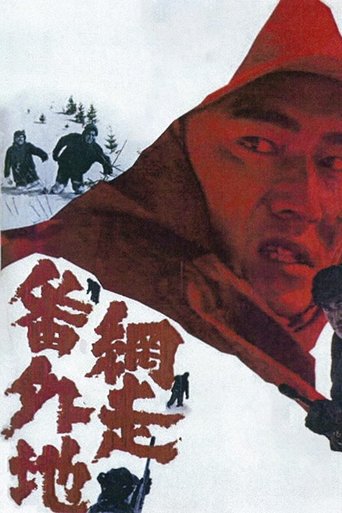
Abashiri Prison (1965)
網走番外地
Abashiri Prison is located in the coldest place in Japan. Two men, handcuffed together have escaped from the prison, one a yakuza, the other a petty criminal, and although they hate each other they must work together if they are to evade capture in this harshest of climates.
- Date of release
- 1965-04-18
- TMDB
- 7.2 / 10 (9)
- Runtime
- 1h 32m
- Genres
- Drama, Thriller, Crime
- Director
- Teruo Ishii
- Collection
- Abashiri Prison Collection
Casting
- Ken Takakura — Shinichi Tachibana
- Kōji Nanbara — Gonzo Gonda
- Kyōsuke Machida — Natsume
- Kanjūrō Arashi — Torakichi Akuda
- Tōru Abe — Heizo Yoda
- Nami Munakata — Tsumaki's Wife
- Kunie Tanaka — Otsuki
- Tetsuro Tamba — Tsumaki
- Kenji Ushio — Prisoner
- Koji Takishima
- Kazu Sugiyoshi
- Seiya Satō
Interesting facts
Abashiri Prison , also known as A Man from Abashiri Prison, is a 1965 Japanese film written and directed by Teruo Ishii. Based on the 1956 novel of the same name by Hajime Itō, Ishii wrote the script as a remake of the 1958 American film The Defiant Ones. The film is the first entry in Toei Company's Abashiri Prison series, which stars Ken Takakura. Highly successful, it was the first hit in the yakuza film genre. Abashiri Prison made Takakura a star and was followed by 17 sequels.
Production
Hajime Itō wrote the 1956 novel Abashiri Bangaichi based on his experience incarcerated at the real Abashiri Prison in the early 1950s. The book was previously adapted into a film by Nikkatsu in 1959. Director Teruo Ishii modeled his version on the 1958 American film The Defiant Ones, which he had wanted to make a Japanese version of ever since he first saw the film.
Ishii said the script was written quickly, but was done without any location scouting, which caused problems when they actually got to Hokkaido. It took a whole month just to find a railroad to shoot the handcar escape scene. They finally found one in Shintoku, but the small town had no inns, and the crew had to stay at a dormitory in the mountains.
Abashiri Prison is known for its titular theme song sung by its lead, Ken Takakura. A traditional folk song sung by prisoners, Ishii had first heard it played by former yakuza in a television documentary. He quickly grabbed a tape recorder and recorded it, and then had the TV station identify it for him. He first used the song in his film Kaoyaku, which was released earlier in 1965, where it was also sung by Takakura.
Read on Wikipedia · Text from Wikipedia, CC BY-SA 4.0. Data from Wikidata.
Recommended
- The Yakuza 1974 · ★ 7.1
- Female Prisoner Scorpion: Jailhouse 41 1972 · ★ 7.0
- Brute Force 1947 · ★ 7.3
- Female Prisoner #701: Scorpion 1972 · ★ 7.0
- Prison Break: The Final Break 2009 · ★ 7.5
- Youth of the Beast 1963 · ★ 6.9
- Convict 2014 · ★ 6.5
- King Ivory 2025 · ★ 7.0
- Bad Boys 1983 · ★ 7.0
- The Young Savages 1961 · ★ 6.5
- Nowhere to Run 1993 · ★ 6.6
- The Devil You Know 2022 · ★ 6.7