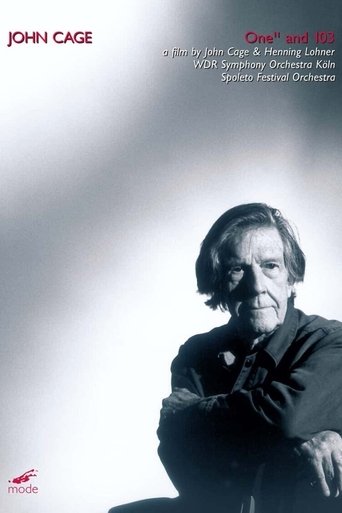
One 11 and 103 (1992)
Avant-garde composer John Cage is famous for his experimental pieces and "chance music" but temporarily branched into video in 1992 with this art film about meaningless activity. The work is composed of two segments that are supposed to be played simultaneously: "One 11" contains the artistic statement, and "103" is a 17-part orchestral piece. Also included is a revealing documentary about Cage and director Henning Lohner.
- Date of release
- 1992-01-01
- TMDB
- 10.0 / 10 (1)
- Runtime
- 1h 30m
- Genres
- Music, Documentary
- Director
- Henning Lohner, John Cage
Casting
Interesting facts
One11 is a 1992 monochrome art film by John Cage and Henning Lohner. It is the only feature-length film production Cage was ever involved in. The film has no plot and consists of black-and-white images depicting a composed and chance-determined play of electric light. It can be accompanied by the orchestra piece 103. Described as "film without subject" and "abstract study in light and shade", it was completed in 1992 only weeks before Cage's death.
Production
For a long time, John Cage had resisted the idea of creating a film. But the German-born Los Angeles film composer Henning Lohner convinced him to make a feature-length film for cinema and TV. Cage reportedly said, laughing, "if I have the opportunity to do something then I jump at it, instead of hesitating, because there isn't much time left!"
As early as in 1952, John Cage had started to address both the perception of emptiness and the random quality of what happens in a prescribed space in his piece 4:33, which consisted entirely of silence. Forty years later, having spoken about silence musically, Cage now wished to treat it visually – through a film about light itself. Cage said, "I think light gives me the pleasure that sound gives.
This concept was implemented professionally in a Munich television studio in 1992 under the direction of Henning Lohner. It was shot in 35mm black-and-white by cameraman Van Theodore Carlson. Filming began on April 22 at a large TV studio in Munich, with a crew of about a dozen TV engineers and technicians. Working with 35 mm cameras on a tripod, crane or hand-held, Carlson often changed their lens openings, as required by the score.
In the DVD released by Mode Records, viewers can choose between two different performances of Cage's orchestral 103 to accompany the film: the version recorded at the premiere by the WDR Symphony Orchestra as well as a version by the Spoleto Festival Orchestra.
Read on Wikipedia · Text from Wikipedia, CC BY-SA 4.0. Data from Wikidata.
Recommended
- Western Stars 2019 · ★ 7.0
- Oasis: Don't Look Back in Anger 2026 · ★ 6.9
- Live Aid 1985 · ★ 7.8
- The Show Must Go On: The Queen + Adam Lambert Story 2019 · ★ 7.3
- Biggie & Tupac 2002 · ★ 6.4
- Billie Eilish - Hit Me Hard and Soft: The Tour (Live in 3D) 2026 · ★ 8.4
- Roger Waters: The Wall 2014 · ★ 8.0
- The Last Waltz 1978 · ★ 7.7
- Daft Punk Unchained 2015 · ★ 7.2
- Adele One Night Only 2021 · ★ 7.7
- Selena Gomez: My Mind & Me 2022 · ★ 8.4
- Justin Bieber's Believe 2013 · ★ 6.9