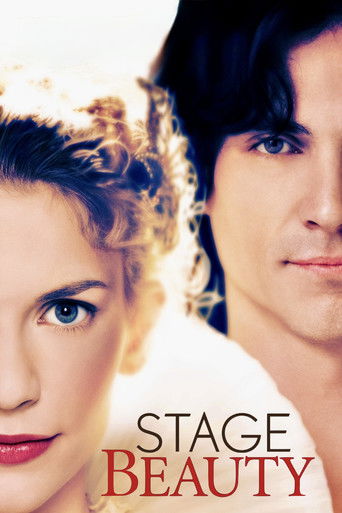
Stage Beauty (2004)
She was the first of her kind. He was the last of his.
Humble Maria, who outfits top London theater star Ned Kynaston, takes none of the credit for the male actor's success at playing women. And because this is the 17th century, Maria, like other females, is prohibited from pursuing her dream of acting. But when powerful people support her, King Charles II lifts the ban on female stage performers. And just as Maria aided Ned, she needs his help to learn her new profession.
- Date of release
- 2004-09-03
- TMDB
- 6.6 / 10 (148)
- Runtime
- 1h 46m
- Genres
- Comedy, Romance
- Director
- Richard Eyre
Casting
- Claire Danes — Maria
- Billy Crudup — Ned Kynaston
- Derek Hutchinson — Stage Manager
- Mark Letheren — Male Emelia/Dickie
- Tom Wilkinson — Betterton
- Ben Chaplin — George Villiars, Duke of Buckingham
- Hugh Bonneville — Samuel Pepys
- Fenella Woolgar — Lady Meresvale
- Richard Griffiths — Sir Charles Sedley
- Clare Higgins — Mistress Revels
- Rupert Everett — King Charles II
- Tom Hollander — Sir Peter Lely
Interesting facts
Stage Beauty is a 2004 romantic period drama directed by Richard Eyre. The screenplay by Jeffrey Hatcher is based on his play Compleat Female Stage Beauty, which was inspired by references to 17th-century actor Edward Kynaston made in the detailed private diary kept by Samuel Pepys.
Production
While the film is rooted in historical fact – the first English theatre actress, although her name is unknown, is believed to have performed the role of Desdemona – some liberties with the truth were taken. Nell Gwynne is represented as a mistress of the King who subsequently becomes an actress, but in reality she already was a noted theatre personality and actress when Charles II met her.
Interiors were filmed at the Old Royal Naval College in Greenwich and Shepperton Studios in Surrey. According to commentary by production designer Jim Clay on the DVD release of the film, because so little English Restoration architecture remains in London, and documentation of the period is minimal, he was required to use his imagination in creating buildings and back alleys on sound stages.
In the DVD commentary, several cast members recall the film was shot during the hottest UK summer on record at the time (2003), and the temperature under the lights usually hovered at 46 °C (115 °F), making performing in the heavy, layered costumes a grueling experience.
The Costumes were designed by Tim Hatley. Twelve costume houses were involved in the production, including The Royal Shakespeare Company, The National Theater, and Angels & Bermans, as well as the Italian houses Sartoria Farani, Tirelli, Costumi d'Arte, E. Rancati, G.P. 11, and Pompei.
The film premiered at the Tribeca Film Festival in May 2004 prior to its general release in the UK. It was shown at the Deauville Film Festival, the Toronto International Film Festival, and the Dinard Festival of British Cinema in France before opening in New York City.
Read on Wikipedia · Text from Wikipedia, CC BY-SA 4.0. Data from Wikidata.
Recommended
- Players 2024 · ★ 6.0
- My Sassy Girl 2008 · ★ 6.8
- The 4:30 Movie 2024 · ★ 5.8
- How I Got Into College 1989 · ★ 6.0
- The Incredible Jessica James 2017 · ★ 6.1
- ¿Quieres ser mi hijo? 2023 · ★ 8.4
- A Nice Girl Like You 2020 · ★ 5.8
- About Last Night 2014 · ★ 6.0
- Anchors Aweigh 1945 · ★ 6.8
- Cuban Fury 2014 · ★ 6.1
- Twentieth Century 1934 · ★ 6.8
- The Taming of the Shrew 1967 · ★ 6.9