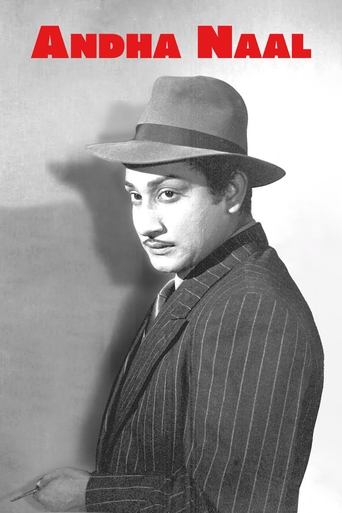
அந்த நாள் (1954)
Rajan, a radio engineer, is found murdered in Madras during the tense World War II era, amid fears of a Japanese air raid on the city. CID officer Sivanandham investigates the case as each suspect—Rajan's wife, lover, relatives, and neighbors—narrates a different version of events, revealing hidden motives and secrets that lead to the truth.
- Data di uscita
- 1954-04-13
- TMDB
- 6.5 / 10 (13)
- Durata
- 2 h 14 min
- Generi
- Thriller, Crime, Mistero
- Regista
- S. Balachander
Cast
- Sivaji Ganesan — Rajan
- Pandari Bai — Usha
- Javar Seetharaman — C. I. D Sivanandam
- P. D. Sambandam — Chinnaiah Pillai
- T. K. Balachandran — Pattabi
- K. Sooryakala — Ambujam
- S. Menaka — Hema
Curiosità
Andha Naal is a 1954 Indian Tamil-language mystery and thriller film, produced by A. V. Meiyappan and directed by S. Balachander. It is the first film noir in Tamil cinema, and the first Tamil film to be made without songs, dance, or stunt sequences. Set in the milieu of World War II, the story is about the killing of a radio engineer Rajan. The suspects are Rajan's wife Usha, the neighbour Chinnaiya Pillai, Rajan's brother Pattabi, Rajan's sister-in-law Hema (Menaka), and Rajan's mistress Ambujam. Each one's account of the incident points to a new suspect.
Production
Director S. Balachander watched Akira Kurosawa's Rashomon (1950) at a film festival, was inspired by it, and wrote a play in the same narrative style, but the script was rejected by All India Radio. He later approached A. V. Meiyappan, the founder of AVM Productions, and narrated the story for him.
The role of the radio engineer Rajan was initially given to S. V. Sahasranamam, who was dismissed after a few days of shooting because Balachander and Meiyappan were not satisfied with his performance and felt he looked "too old" to play the role. The makers then engaged newcomer N. Viswanathan, a Tamilian professor from Calcutta (now Kolkata).
Since Meiyappan had introduced Ganesan in Parasakthi (1952), he was very keen to have him play the lead role. Initially, Balachander was hesitant to approach Ganesan because he was unsure whether he would agree to play a negative role. In his autobiography, Ganesan said the film was almost completed before he was approached.
Ganesan initially demanded a sum of ₹40,000 (equivalent to ₹4.4 million or US$46,000 in 2026) for the film, which Meiyappan could not afford to pay. He offered to pay him ₹25,000 (equivalent to ₹2.8 million or US$29,000 in 2026), which Ganesan declined. Balachander, however, convinced Ganesan that Meiyappan would pay him ₹1,000 (equivalent to ₹110,000 or US$1,100 in 2026) for every day they shot the film.
V. Srinivasan—who later became popularly known as Muktha Srinivasan—assisted Balachander with the film. Cinematography was handled by S. Maruti Rao, and editing was done by S. Surya. The background score was recorded by Saraswathy Stores Orchestra, AVM Productions' music troupe. Two Hindi songs are used in the film in instrumental form: "Yeh Zindagi Usi Ki Hai" from Anarkali (1953) and "Chup Chup Khade Ho" from Bari Behen (1949).
Leggi su Wikipedia · Testo da Wikipedia, CC BY-SA 4.0. Dati da Wikidata.
Consigliati
- Una donna nel lago 1946 · ★ 6.1
- Agatha Christie: Delitto in tre atti 1986 · ★ 6.0
- Assassinio allo specchio 1980 · ★ 6.1
- Quiller memorandum 1966 · ★ 5.9
- La città nuda 1948 · ★ 7.2
- I giovani uccidono 1950 · ★ 6.6
- L'alibi dell'ultima ora 1957 · ★ 6.5
- Il maniaco 1963 · ★ 6.2
- Por Thozhil 2023 · ★ 7.3
- The Interview 1998 · ★ 6.8
- Islands 2025 · ★ 6.1
- Delitto sotto il sole 1982 · ★ 6.9