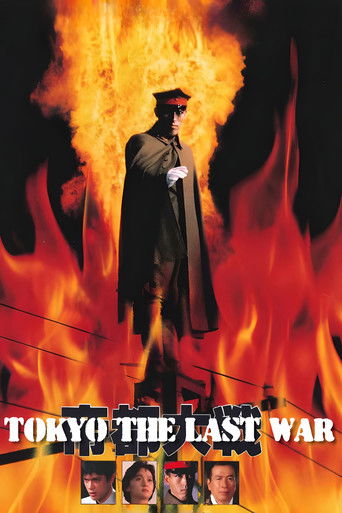
Tokyo: The Last War (1989)
帝都大戦
In 1945, after the horrific fire-bombings of the Pacific War levels Japan to the ground, the government consults spiritual psychics to aid them in winning the war. Unfortunately, the souls' resentment and agony of the victims culminate together to revive the evil Onmyoji, Yasunori Kato. Only a young, psychically imbued priests' apprentice will dare fight the evil magician.
- Date of release
- 1989-09-15
- TMDB
- 6.3 / 10 (9)
- Runtime
- 1h 47m
- Genres
- Fantasy, Science Fiction, Horror
- Director
- Takashige Ichise
- Collection
- Teito Monogatari Collection
Casting
- Kyusaku Shimada — Yasunori Kato
- Kaho Minami — Yukiko Tasumiya
- Naoko Nozawa — Reiko Mizuki
- Eriko Togaki — Mioto
- Yousuke Saito — Second Lieutenant Mori
- Masaya Katō — Yuko Nakamura
- Takeshi Kusaka — Fumimaro Konoe
- Tetsuro Tamba — Kanaami Kohou
- Yoshio Tsuchiya — Dr. Mizuno
- Brien Uhl — Wagner
- Tadao Nakamaru — Chief Engineer Nimura
- Aya Katsuragi — Junko
Interesting facts
- Based on: Teito Monogatari
Tokyo: The Last War is a 1989 Japanese epic tokusatsu historical dark fantasy/science fiction film directed by Takashige Ichise and distributed by Toho Studios. It is an adaptation of the eleventh book of the Teito Monogatari novel by Hiroshi Aramata. It is the second cinematic adaptation of the Teito Monogatari series and is a sequel to Tokyo: The Last Megalopolis.
Production
The box-office success of Tokyo: The Last Megalopolis prompted a sequel to immediately be put into production. The film also marked the directorial debut of Takashige Ichise, a Japanese film producer best known in the west for financing such J-Horror classics as Ring, Ju-on: The Grudge, and Dark Water as well as their respective Hollywood remakes.
With fewer resources, Ichise determined the sequel should be more akin to an action movie than an epic film. This change was also made in response to criticisms that the plot of the first movie had been difficult for general audiences to understand. The plot adapted only a single book in the series (as opposed to the first film, which had adapted the plot of four books).
The open set was built in Sasebo, Nagasaki Prefecture, on a scale larger than that of Tokyo: The Last Megalopolis. Filming took place in Nagasaki for about a month, but was marred by continuous rain . Miniatures were hardly used as in the previous film, and the action scenes were centered on the open set.
Read on Wikipedia · Text from Wikipedia, CC BY-SA 4.0. Data from Wikidata.
Recommended
- Dororo 2007 · ★ 7.0
- Demon City Shinjuku 1988 · ★ 6.0
- Gantz: Perfect Answer 2011 · ★ 6.6
- Samurai Reincarnation 1981 · ★ 5.8
- Attack on Titan II: End of the World 2015 · ★ 6.3
- Blade II 2002 · ★ 6.6
- The Unhealer 2021 · ★ 5.8
- X 1996 · ★ 6.2
- Books of Blood 2020 · ★ 6.2
- Devilman 2004 · ★ 6.1
- Bleach the Movie: Memories of Nobody 2006 · ★ 6.9
- Gantz 2010 · ★ 6.5