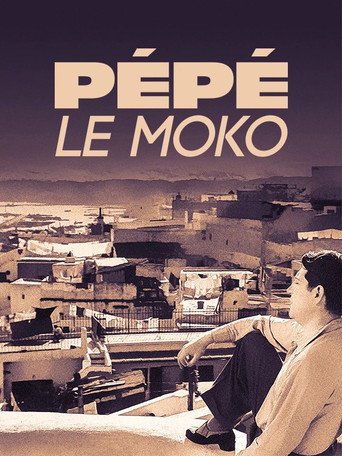
Pépé le Moko (1937)
Pépé le Moko, one of France's most wanted criminals, hides out in the Casbah section of Algiers. He knows police will be waiting for him if he tries to leave the city. When Pépé meets Gaby, a gorgeous woman from Paris who is lost in the Casbah, he falls for her.
- Data lansării
- 1937-01-28
- TMDB
- 7.2 / 10 (200)
- Durată
- 1 h 34 min
- Genuri
- Dramă, Crimă, Romantic
- Regizor
- Julien Duvivier
Distribuție
- Jean Gabin — Pépé le Moko
- Mireille Balin — Gaby, the Parisian
- Gabriel Gabrio — Carlos
- Lucas Gridoux — Inspector Slimane
- Gilbert Gil — Pierrot
- Line Noro — Inès, Pépé's mistress
- Saturnin Fabre — The Great Father
- Fernand Charpin — Régis
- Marcel Dalio — L'Arbi
- Charles Granval — Maxime
- Gaston Modot — Jimmy
- René Bergeron — Meunier
Curiozități
- Filmat în: Marsilia
Pépé le Moko is a 1937 French film directed by Julien Duvivier starring Jean Gabin, based on a novel of the same name by Henri La Barthe and with sets by Jacques Krauss. An example of the 1930s French movement known as poetic realism, it recounts the trapping of a gangster on the run in Algiers, who believes that he is safe from arrest in the Casbah.
Production
Principal photography for the film was shot at a replica of the Casbah at Joinville-le-Pont, near Paris, and only exterior shots were filmed in Algiers. Lead actress Mireille Balin never set foot in Algeria during the making of the film.
The set design that Jacques Krauss created for the film established the setting in the Casbah. With little to no location shooting, Krauss' work was central to the production of the film. At that time in French cinema, shooting on sets was preferred to location shooting because of the artistic control it gave to designers such as Krauss.
Duvivier utilized multiple methods of creating a sense of realism despite filming on a set. He introduced the setting of the Casbah with documentary style footage. This included longer establishing shots of the Casbah in its entirety along with shorter shots that showed the chaotic atmosphere. Also, Duvivier included longer shots when focusing on characters. This technique made scenes feel like they were happening in real time.
Another element of the production was the film noir style. Multiple shots include the shadow of venetian blinds or other pieces of Krauss' set design that obscure characters with shadows, which is a common effect used in the genre of film noir.
Dialogue was important to French filmmaking at the time Pépé le Moko was made because of the recent introduction of sound. The screenplay and dialogue were written separately for this film with Henri La Barthe, Julien Duvivier, and Jacques Constant credited for writing the screenplay, and Henri Jeanson for the dialogue.
Citește pe Wikipedia · Text din Wikipedia, CC BY-SA 4.0. Date din Wikidata.
Recomandate
- Fallen Angel 1945 · ★ 6.6
- Mireasa era în negru 1968 · ★ 7.1
- The Seventh Juror 1962 · ★ 6.8
- Forța brută 1947 · ★ 7.3
- Confessions of a Hitman 2022 · ★ 6.3
- The Mask of Dimitrios 1944 · ★ 7.1
- A Kiss Before Dying 1956 · ★ 6.3
- Noaptea vânătorului 1955 · ★ 7.8
- Symphony for a Massacre 1963 · ★ 6.7
- Sahara 1983 · ★ 5.9
- Aurora Teagarden Mysteries: Haunted By Murder 2022 · ★ 7.0
- Port of Shadows 1938 · ★ 7.4