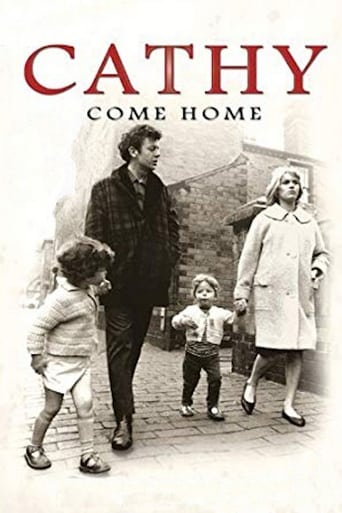
캐시 집에 오다 (1966)
Cathy Come Home
1960년대 TV드라마 중 가장 뜨거운 반응을 이끌어낸 작품. 홈리스가 된 가족 이야기로, 다큐멘터리 기법을 활용해 관료적 복지제도가 어떻게 가족을 해체시키는지를 다룬 작품
출연진
- Carol White — Cathy Ward
- 레이 브루크스 — Reg Ward
- Wally Patch — Grandad
- Adrienne Frame — Eileen
- Winifred Dennis — Mrs. Ward
- Emmett Hennessy — Johnny
- Alec Coleman — Wedding Guest
- Geoffrey Palmer — Property Agent
- Gabrielle Hamilton — Welfare Officer
- Phyllis Hickson — Mrs. Alley
- Frank Veasey — Mr. Hodge
- Barry Jackson — Rent Collector
흥미로운 사실
"Cathy Come Home" is a 1966 BBC television play about homelessness. It was written by Jeremy Sandford, produced by Tony Garnett and directed by Ken Loach. A 1998 Radio Times readers' poll voted it the "best single television drama" and a 2000 industry poll rated it as the second-best British television programme ever made. Filmed in a gritty, realistic drama documentary style, it was first broadcast on 16 November 1966 on BBC1. The play was shown in the BBC's The Wednesday Play anthology strand, which often tackled social issues.
Production
The play was written by Jeremy Sandford, produced by Tony Garnett and directed by Ken Loach, who went on to become a major figure in British film. Loach employed a realistic documentary style, using predominantly 16 mm film on location, which contrasted with the vast amount of BBC drama of the time, the bulk of which was entirely shot in a television studio.
The cinematographer was Tony Imi, whose innovative use of a hand-held camera to take moving action shots and close-ups gave Cathy Come Home almost a feel of a current affairs broadcast and a realism which was rare in British television drama at the time. This produced shots some traditionalists thought "not technically acceptable". Imi commented: "I was stuck in a rut after working on Dr Finlay's Casebook and Maigret – standard BBC productions.
Loach's naturalistic style helped to heighten the play's impact. Many scenes were improvised, and some include unknowing members of the public, such as the final scene in which Cathy's children are taken from her at a railway station (none of the passers-by intervened).
The song that is played at the beginning and end of the film is a cover version of "500 Miles" by Sonny & Cher.
위키백과에서 더 읽기 · 텍스트 출처: 위키백과, CC BY-SA 4.0. 데이터 출처: Wikidata.
추천
- 홈리스 투 하버드 - 더 리즈 머리 스토리 2003 · ★ 7.3
- TalhotBlond 2012 · ★ 6.3
- Heaven 2019 · ★ 6.2
- The Christmas Shoes 2002 · ★ 6.8
- 마이 디너 위드 허브 2018 · ★ 6.3
- Cheaters 2000 · ★ 6.3
- 천사의 투쟁 2004 · ★ 6.8
- 돌리 파튼스 코트 오브 매니 컬러스 2015 · ★ 6.5
- Rebound: The Legend of Earl 'The Goat' Manigault 1996 · ★ 7.1
- Return to Zero 2014 · ★ 6.6
- 모리와 함께 한 화요일 1999 · ★ 7.4
- 미국의 아들 2019 · ★ 6.0