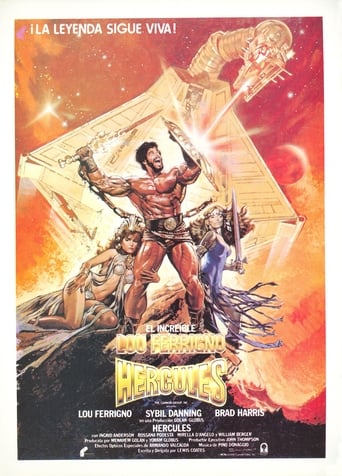
El desafío de Hércules (1983)
Hercules
Hercules, que tenia tanta fuerza como cien hombres, fue enviado desde los cielos por Zeus para combatir al Rey Minos y a su malvada hija Arianna, que intentaban someter a todo el género humano. Ya entre los hombres, el Rey Augelius, impresionado por su fuerza, le otorga el honor de ser el guardián de su hija Cassiopea. Hércules cumplirá su tarea, llevando a cabo fabulosas aventuras y combatiendo como un héroe invencible contra la malvada Arianna y el Rey Minos.
- Fecha de estreno
- 1983-08-12
- TMDB
- 5.0 / 10 (129)
- Duración
- 1 h 38 min
- Géneros
- Acción, Aventura, Fantasía
- Director
- Luigi Cozzi
- Colección
- Hércules - Colección
Reparto
- Lou Ferrigno — Hercules
- Sybil Danning — Ariadne
- Brad Harris — Augias
- Rossana Podestà — Hera
- Ingrid Anderson — Cassiopea
- Mirella D'Angelo — Circe
- William Berger — King Minos
- Bobby Rhodes — King Xenodama
- Gianni Garko — Valcheus
- Delia Boccardo — Athena
- Claudio Cassinelli — Zeus
- Franco Garofalo — The Thief
Curiosidades
- Recaudación: 10,7 M US$
- Presupuesto: 2,5 M US$
- Recaudó 4,3× su presupuesto
- Premios: 2 · Nominaciones: 5. Incluyendo: Anexo:Razzie a la peor actriz de reparto; Golden Raspberry Award for Worst New Star
Hercules is a 1983 fantasy film written and directed by Luigi Cozzi and starring bodybuilder-turned-actor Lou Ferrigno, Brad Harris, Sybil Danning, and William Berger. It is loosely based on Greek mythology, plus elements of Cozzi's earlier science fiction opus Starcrash. It received mostly negative reviews, but was a modest financial success. Ferrigno reprised his role in the 1985 sequel, The Adventures of Hercules.
Production
The revival of Hercules was motivated by the hype surrounding 1982's Conan The Barbarian. Menahem Golan also told Luigi Cozzi that he was a fan of the old Italian peplums, and wanted to make one as soon as he opened an Italian branch of his Cannon Films outfit.
The film was revealed to the press in March 1982, with photography slated for May. It was then to be directed by Bruno Mattei and produced by his frequent partner, Israeli Alexander Hacohen. The project was later split into two separate films, Hercules and Hercules and the Seven Gladiators, to be shot back-to-back.
Gladiators was shot first, but Mattei had misfortunes during its making. Two conflicting versions exist. Mattei claims that Cozzi conspired to have him removed by denigrating the planned script for Hercules, and tempting Cannon with a more effects-driven vision. According to Cozzi, Cannon was simply displeased with the dailies of The Seven Magnificent Gladiators, and so fired Mattei.
Upon the film's announcement, Ricardo Ghione was briefly listed as the screenwriter, but he was soon replaced by Mattei regular Claudio Fragasso. Under Mattei and Fragasso, it was intended as a much more straightforward re-imagining of 1958's Hercules.
Author Gary Allen Smith notes that aside from the cleaning of the Augean stables, the Twelve Labours of Hercules are seldom represented on screen. Additionally, he romances Cassiopeia, which does not happen in the Greek myth, and is the orphaned son of King Amphitryon of Thebes, which contradicts it outright. Ferrigno also insisted that the script be excised of its more adult elements, as he held a responsibility toward the child audience.
Leer en Wikipedia · Texto de Wikipedia, CC BY-SA 4.0. Datos de Wikidata.
Recomendadas
- Hércules y el reino perdido 1994 · ★ 6.0
- Hercules y las amazonas 1994 · ★ 5.8
- El reino prohibido 2008 · ★ 6.7
- Rey Arturo: La leyenda de Excalibur 2017 · ★ 6.6
- Dragonheart (Corazón de dragón) 1996 · ★ 6.6
- Warcraft: El origen 2016 · ★ 6.4
- Tigre y dragón 2: La espada del destino 2016 · ★ 6.2
- Lady Halcón 1985 · ★ 7.0
- Jack, el cazagigantes 2013 · ★ 5.9
- Batman contra Drácula 2005 · ★ 7.0
- Damsel 2024 · ★ 7.0
- John Carter 2012 · ★ 6.4