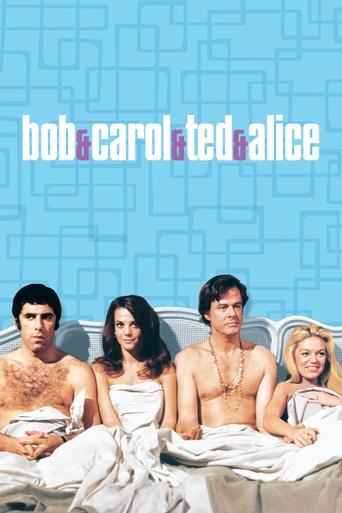
ボブ&キャロル&テッド&アリス (1969)
Bob & Carol & Ted & Alice
After returning to Los Angeles from a group therapy session, documentary filmmaker Bob Sanders and his wife, Carol, find themselves becoming vigilante couples counselors, offering unsolicited advice to their best friends, Ted and Alice Henderson. Not wanting to be rude, the Hendersons play along, but some latent sexual tension among the four soon comes bubbling to the surface, and long-buried desires don't stay buried for long.
- 公開日
- 1969-10-08
- TMDB
- 6.3 / 10 (124)
- 上映時間(分)
- 1時間45分
- ジャンル
- コメディ, ドラマ
- 監督
- ポール・マザースキー
キャスト
- ナタリー・ウッド — Carol Sanders
- ロバート・カルプ — Bob Sanders
- エリオット・グールド — Ted Henderson
- ダイアン・キャノン — Alice Henderson
- Horst Ebersberg — Horst
- Lee Bergere — Emilio
- Donald F. Muhich — Psychiatrist
- Noble Lee Holderread Jr. — Sean Sanders
- K.T. Stevens — Phyllis
- Celeste Yarnall — Susan
- Lynn Borden — Cutter
- Linda Burton — Stewardess
豆知識
- 興行収入:$3190万
- 製作費:$200万
- 製作費の16倍を稼ぎました
- 受賞:0 · ノミネート:4
Bob & Carol & Ted & Alice is a 1969 American comedy-drama film directed by Paul Mazursky, written by Mazursky and Larry Tucker, who also produced the film, and starring Natalie Wood, Robert Culp, Elliott Gould, and Dyan Cannon. The original music score was composed by Quincy Jones. The cinematography for the film was by Charles Lang. The film received four Academy Award nominations, including ones for Gould and Cannon. Patricia Welles wrote the paperback novelization from Mazursky and Tucker's screenplay.
Production
Director Paul Mazursky was inspired by an article he read in Time magazine about Fritz Perls, a "gestalt therapist" that was described as being in a hot tub with naked people at a place called the Esalen Institute (located in the Slates Hot Springs in Big Sur, California), a place formed in 1962 dealing with New Age therapy. Mazursky went there with his wife as the only two people in the group who knew each other.
The original ending in the first draft involved the four characters crying in each other's arms after an aborted orgy, complete with pulling themselves together on their way to a Tony Bennett show. Instead, Mazursky went with an ending that sees the characters walk with each other back outside while "What the World Needs Now Is Love" plays in the background, which he called his "Fellini ending", as it resembled the ending to 8½ (1963).
Wikipediaで続きを読む · テキストはWikipedia、CC BY-SA 4.0。データはWikidata。
おすすめ
- バンド・エイド 2017 · ★ 6.3
- Your Friends & Neighbors 1998 · ★ 5.8
- トータリー・ファックト・アップ 1994 · ★ 6.6
- Somewhere in Queens 2023 · ★ 6.3
- The Clique 2008 · ★ 5.9
- Shane Gillis: Beautiful Dogs 2023 · ★ 7.1
- リッキー・ジャーヴェイスのどうせ皆死ぬ 2025 · ★ 6.9
- ビル・バー:ドロップ・デッド・イヤーズ 2025 · ★ 7.2
- ジ・オーバーナイト 2015 · ★ 5.9
- ハピネス 1998 · ★ 7.4
- In the Soup 1992 · ★ 6.8
- インターベンション 2016 · ★ 5.8