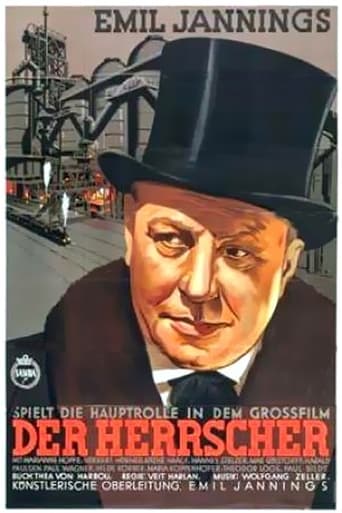
Der Herrscher (1937)
Der Herrscher (The Sovereign) was based on Before Sunset, a play by Gerhart Hauptmann. The great Emil Jannings stars as Mathias Clausen, a self-made businessman who is forced to do a great deal of soul-searching when his wife unexpectedly dies. Determining to start life anew, he falls in love with his secretary Inken (Marianne Hoppe) and impulsively takes a vacation to Italy. Clausen's selfish grown children, not wishing to share their father's affections -- nor his money -- with his new wife-to-be, go to court demanding that Clausen be declared mentally incompetent. Upon finding this out, Clausen flies into a rage, leaving the audience to wonder whether or not he really as gone off his trolley. Der Herrscher was directed by Veit Harlan, more famous (or notorious) for his viciously anti-Semitic Jud Suess (1940).
- Fecha de estreno
- 1937-03-17
- TMDB
- 5.7 / 10 (3)
- Duración
- 1 h 43 min
- Géneros
- Drama
- Director
- Veit Harlan
Reparto
- Emil Jannings — Matthias Clausen
- Marianne Hoppe — Inken Peters
- Hilde Körber — Bettina Clausen
- Käthe Haack — Ottilie Klamroth
- Herbert Hübner — Direktor Erich Klamroth
- Maria Koppenhöfer — Klothilde Clausen
- Paul Bildt — Diener Winter
- Heinrich Schroth — Direktor Hofer
- Max Gülstorff — Sanitätsrat Geiger
- Harald Paulsen — Rechtsanwalt Hanefeld
- Paul Wagner — Professor Wolfgang Clausen
- Hannes Stelzer — Egert
Curiosidades
The Ruler is a 1937 German drama film directed by Veit Harlan. It was adapted from the play of the same name by Gerhart Hauptmann. Erwin Leiser calls it a propagandistic demonstration of the Führerprinzip of Nazi Germany. The film's sets were designed by the art director Robert Herlth. Location shooting took place around Oberhausen and Pompeii near Naples. It premiered at the Ufa-Palast am Zoo in Berlin.
Production
Curt J. Braun and Thea von Harbou loosely adapted Before Sunset by Nobel Prize recipient Gerhart Hauptmann for the purposes of Nazi propaganda. Clausen's character is significantly changed from being destroyed by his family's greed in the book to renouncing his family and helping rebuild Germany in the film.
Veit Harlan, who directed the film, stated that Joseph Goebbels and Walther Funk directly added Nazi slogans to the script and entirely rewrote Clausen's ending speech. Harlan wanted to leave the project as he felt the play was altered too much, but was kept on by Goebbels. Arnold Räther, the vice president of the Reich Chamber of Film, oversaw the production.
Leer en Wikipedia · Texto de Wikipedia, CC BY-SA 4.0. Datos de Wikidata.
Recomendadas
- La extraordinaria vida de Eleanor 2025 · ★ 6.8
- Hounddog 2008 · ★ 6.5
- A la vuelta de la esquina 2018 · ★ 6.9
- El sonido del silencio 2019 · ★ 5.9
- El Refugio 2020 · ★ 6.1
- La joven 1960 · ★ 7.0
- Agente oculto 2022 · ★ 6.3
- Hasta el fin del mundo 1991 · ★ 6.7
- ¿Qué hacemos con Maisie? 2013 · ★ 7.1
- Algún día nos lo contaremos todo 2023 · ★ 5.8
- Salomé 2013 · ★ 6.1
- Un hermano famoso 2015 · ★ 7.0