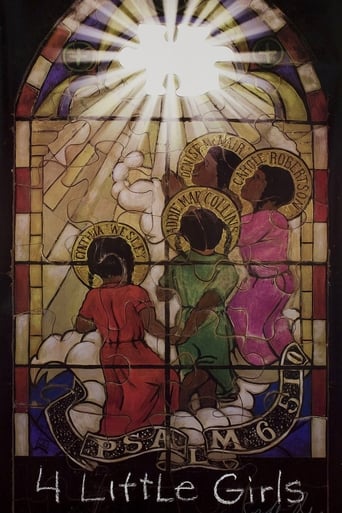
4 Little Girls (1997)
On September 15, 1963, a bomb destroyed a black church in Birmingham, Alabama, killing four young girls who were there for Sunday school. It was a crime that shocked the nation--and a defining moment in the history of the civil-rights movement. Spike Lee re-examines the full story of the bombing, including a revealing interview with former Alabama Governor George Wallace.
キャスト
- Maxine McNair — Self - Mother of Denise McNair
- Chris McNair — Self - Father of Denise McNair
- Helen Pegues — Self - Denise's Aunt
- Queen Nunn — Self - Neighbor of Denise McNair
- Arthur Hanes Jr. — Self - Defense Attorney for Bob Chambliss
- Howell Raines — Self - New York Times Editor
- Harold McNair — Self - Denise's Uncle
- Carole C. Smitherman — Self - Denise's Childhood Friend
- Wamo Reed Robertson — Self - Carole's Aunt
- Dianne Braddock — Self - Carole's Sister
- Carolyn Lee Brown — Self - Carole's Childhood Friend
- Alpha Robertson — Self - Mother of Carole Robertson
豆知識
- 受賞:3 · ノミネート:4. 主な受賞:Broadcast Film Critics Association Award for Best Documentary Film; オンライン映画批評家協会賞 ドキュメンタリー映画賞; サテライト賞 ドキュメンタリー映画賞
4 Little Girls is a 1997 American historical documentary film about the murder of four African-American girls in the 16th Street Baptist Church bombing in Birmingham, Alabama on September 15, 1963. The film was directed by Spike Lee and nominated for an Academy Award for Best Documentary.
Production
Lee first became interested in making a film about the Birmingham bombing in 1983, when he was a student at New York University. After reading a New York Times Magazine article about the incident, he was moved to write to Chris McNair, the father of Denise, one of the victims, to ask for permission to tell her story on film. McNair turned down the young, aspiring filmmaker. "I was entering my first semester at N.Y.U.
According to McNair, he changed his mind about supporting Lee's film idea due to learning about the depth and precision of Lee's research. McNair said, "[I]t's very important that this be done accurately and correctly. In all his research, he [Lee] showed that he was objective and seeking a broad section of opinion. I'm a stickler for the facts."
At first, Lee had intended to create a dramatic reproduction of the incident, but eventually, he decided that would not be the best approach, and the project became a documentary. Once he secured funding, he went to Birmingham with a small skeleton film crew, as he wanted the families to be as comfortable as possible during the interviews. Sam Pollard served as a producer and the editor and Ellen Kuras was the director of photography of the film.
Lee had developed a relationship with Kuras while working on an HBO project called Subway Stories, which was an anthology of short films compiled by Jonathan Demme (though Lee's film did not make the final cut due, in part, to conflict between him and Demme). Kuras said of her desire to shoot 4 Little Girls, "I was really interested because my background is in political documentaries ...
Lee's partnership with Sam Pollard had begun on Mo' Better Blues when Pollard was recommended to replace Barry Alexander Brown, who was unavailable because he was directing his own film, as editor. Pollard originally refused the overture because he was busy working on his segments of Eyes on the Prize, but ultimately, he accepted, and he has since become one of Lee's most frequent collaborators.
Wikipediaで続きを読む · テキストはWikipedia、CC BY-SA 4.0。データはWikidata。
おすすめ
- The Godfather Family: A Look Inside 1990 · ★ 7.8
- Louis Theroux: Twilight of the Porn Stars 2012 · ★ 6.3
- The Green Book: Guide to Freedom 2019 · ★ 7.8
- Unlocking Sherlock 2014 · ★ 7.9
- Seven Up! 1964 · ★ 7.2
- The Class of ‘92 2013 · ★ 7.1
- Night Will Fall 2014 · ★ 7.6
- Directed by John Ford 1971 · ★ 7.0
- A Toxic Love Story 2026 · ★ 6.5
- Seduced and Abandoned 2013 · ★ 6.2
- ReMastered: The Two Killings of Sam Cooke 2019 · ★ 6.8
- The Making of Star Wars 1977 · ★ 7.1