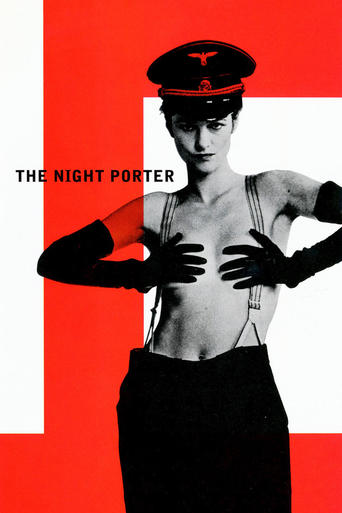
The Night Porter (1974)
Il portiere di notte
The Most Controversial Picture of Our Time!
A concentration camp survivor discovers her former torturer and lover working as a porter at a hotel in postwar Vienna. When the couple attempt to re-create their sadomasochistic relationship, his former SS comrades begin to stalk them.
- Date of release
- 1974-04-03
- TMDB
- 6.7 / 10 (406)
- Runtime
- 1h 58m
- Genres
- War, Drama, Romance
- Director
- Liliana Cavani
Casting
- Dirk Bogarde — Max
- Charlotte Rampling — Lucia
- Philippe Leroy — Klaus
- Gabriele Ferzetti — Hans
- Giuseppe Addobbati — Stumm
- Isa Miranda — Countess Stein
- Nino Bignamini — Adolph
- Marino Masé — Atherton
- Amadeo Amodio — Bert
- Piero Vida — Day Porter
- Geoffrey Copleston — Kurt
- Manfred Freyberger — Dobson
Interesting facts
- Box office: $633.3K
- Filmed in: Vienna
The Night Porter is a 1974 Italian erotic psychological war drama film co-written and directed by Liliana Cavani. It stars Dirk Bogarde and Charlotte Rampling, with Philippe Leroy, Gabriele Ferzetti, and Isa Miranda in supporting roles. Set in Vienna in 1957, the film centers on the sadomasochistic relationship between a former Nazi extermination camp officer (Bogarde) and one of his inmates (Rampling).
Production
Director Liliana Cavani co-wrote the screenplay for The Night Porter with Italo Moscati, Barbara Alberti, Amedeo Pagani. Cavani developed the idea for the film while making the 1965 documentary Women in the Resistance (Italian: La donna nella Resistenza) for Italian television on internment camps. During a halt in the production due to weather conditions, Cavani observed a woman placing a sheaf of roses at the site of a former prisoner camp.
As part of the documentary, Cavani interviewed the partisan and Ravensbrück survivor Lidia Beccaria Rolfi. The scholar Giovanni Miglianti posits that the film was greatly inspired by Beccaria's testimony, particulaty Cavani's interpretation of Beccaria's annual visit to Ravensbrück as being sexual in nature. Miglianti further posits that Beccaria's 1978 work Le donne di Ravensbrück.
Filming took place in Vienna and at Cinecittà Studios in Rome. Locations included the Vienna Volksoper, the Linke Wienzeile Buildings, the Mozarthaus, the Vienna Central Cemetery, Karl-Marx-Hof, and Schönbrunn Palace. The concentration camp scenes were shot in the Tuscolano district of Rome. The film's costumes were designed by five-time Oscar-nominee Piero Tosi.
The budget, which had been paid for by the Italian distributor, ran out near the end of the shooting of the film's interiors at Cinecittà. To ensure the film's completion, producer Robert Gordon Edwards instructed editor Franco Arcalli to create a rough cut of the best scenes that had been shot, which he presented to an American colleague who worked at Les Artistes Associés (the French arm of United Artists).
Romy Schneider turned down the role of Lucia. Mia Farrow was considered, as well as Dominique Sanda, before Charlotte Rampling was cast. Rampling shot the film only four months after giving birth to her son Barnaby. She and Dirk Bogarde re-wrote and ad-libbed much of their dialogue. Bogarde also enlisted Anthony Forwood to help rewrite the script, uncredited.
Read on Wikipedia · Text from Wikipedia, CC BY-SA 4.0. Data from Wikidata.
Recommended
- Escape from Sobibor 1987 · ★ 7.2
- Bent 1997 · ★ 6.9
- Triumph of the Spirit 1989 · ★ 6.5
- The Key 1983 · ★ 6.0
- The Duke of Burgundy 2015 · ★ 6.3
- Walking with the Enemy 2014 · ★ 6.3
- Ike: Countdown to D-Day 2004 · ★ 6.5
- A Midnight Clear 1992 · ★ 6.5
- Intimacy 2001 · ★ 6.2
- Casualties of War 1989 · ★ 7.2
- Men in War 1957 · ★ 6.6
- Original Sin 2001 · ★ 6.2