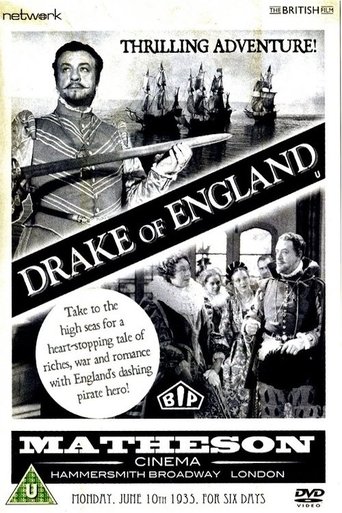
Drake of England (1935)
Imposing Canadian-born stage actor and playwright Matherson Lang was one of the twentieth century's great Shakespearean players, and became Britain's foremost screen actor during the 1920s; in Drake of England, one of his final films, he takes the title role in Arthur Woods' portrayal of the life and times of the flamboyant piratical adventurer who founded Britain's sea fortunes. From clandestine romance at the court of Elizabeth I to conquests in the newly discovered lands of South America and spectacular victory over the Armada, Drake of England offers a panoramic overview of Drake's life.
- 上映日期
- 1935-05-16
- TMDB
- 6.8 / 10 (5)
- 片长(分钟)
- 1小时44分钟
- 类型
- 动作, 剧情
- 导演
- Arthur B. Woods
演员阵容
- Matheson Lang — Francis Drake
- Jane Baxter — Elizabeth Sydenham
- 雅典娜·塞勒 — Queen Elizabeth
- Henry Mollison — John Doughty
- Donald Wolfit — Thomas Doughty
- Ben Webster — Lord Burghley
- George Merritt — Tom Moore
- Amy Veness — Mother Moore
- Sam Livesey — Sir George Sydenham
- Margaret Halstan — Lady Sydenham
- Charles Quatermaine — Parson Fletcher
- Allan Jeayes — Don Bernardino
趣闻
Drake of England is a 1935 British drama film directed by Arthur B. Woods and starring Matheson Lang, Athene Seyler and Jane Baxter. It depicts the life of Francis Drake and the events leading up to the defeat of the Armada in 1588.
Production
The film was made at Elstree Studios, as part of the boom in historical films that followed the global success of The Private Life of Henry VIII. The film was based on the play of the same title by Louis N. Parker. The art direction was by Duncan Sutherland who designed the film's sets. It was given an American release in 1936, when it was distributed by Grand National Pictures.
The film has generally been overshadowed by two slightly later releases, Fire Over England (1937) and The Sea Hawk (1940), which deal with much the same story.
Ronald Neame was assistant camera man. He said Matheson Lang's "fifty-five years and overly generous girth flew somewhat in the face of the slim, historical figure he was portraying." He said during the shoot Claude Friese-Greene, the cinematographer, was drinking heavily and fell ill and wound up in hospital, meaning Neame had to take over. The film was crucial in Neame's career. Filming finished May 1935.
在维基百科阅读更多 · 文本来自维基百科,CC BY-SA 4.0。数据来自 Wikidata。