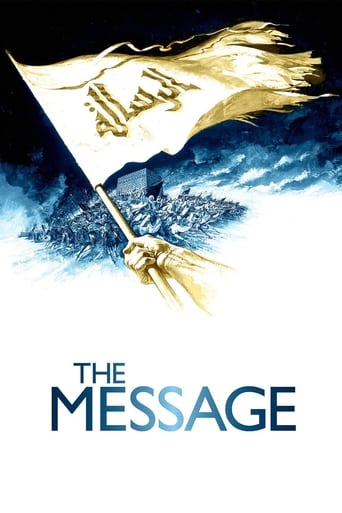
上帝的使者 (1976)
The Message
影片诞生于1976年,是穆斯塔法·阿基德的经典名作,《时代周刊》世纪把它评为百大佳片之一,由安东尼·奎恩主演。伊斯兰是入世的宗教,提倡政教合一。公元七世纪,在强权者的独裁统治下,奴隶制、不同的贫富差距、社会暴力犯罪等等现象屡出不鲜。伊斯兰信徒穆罕默德揭竿而起,为自由与尊重与荒淫、专横的统治者展开了斗争。伊斯兰教徒们在共同信仰的团结下,毫不畏惧地反抗强大的敌人,展开了一场捍卫真主与纯洁的圣战。故事以此为基点,以独特的方式展开。麦加,七世纪,穆罕默德与城市的强权者们斗争着,他揭露他们的专横,以及它造成的疾病-奴隶制,暴力,酗酒,特别是,穆罕默德和穆斯林们鼓励人们忘却旧偶像,只崇拜唯一的真主,他们的对手毫不犹豫的迫害并折磨他们的近亲。然而,和平的穆斯林们明白,该为尊重自己的正义而奋战…
演员阵容
- 安东尼·奎恩 — Hamza
- 艾琳·帕帕斯 — Hind
- Michael Ansara — Abu Sufyan
- Johnny Sekka — Bilal
- Michael Forest — Khalid
- 加里克·哈根 — Ammar
- Nicholas Amer — Suheil
- Damien Thomas — Zaid
- 安德烈·莫雷尔 — Abu-Talib
- 马丁·本森 — Abu-Jahal
- Robert Brown — Otba
- 罗莎莉·克拉切利 — Somaya
趣闻
- 预算:US$1700万
- 拍摄地:利比亞和摩洛哥
- 获奖:0 · 提名:1
The Message originally known as Mohammed, Messenger of God is a 1976 epic film directed and produced by Moustapha Akkad that chronicles the life and times of Muhammad, who is never directly depicted.
Production
Moustapha Akkad considered creating a film about Muhammad and the birth of Islam in 1967. The film's script, written by H.A.L. Craig, was approved in its entirety by Tawfiq al-Hakim, a scholar at Al-Azhar University. However, the film's approval was revoked and referred to as "an insult to Islam".
$10 million was raised for the film from Kuwait, Libya, Morocco, Saudi Arabia and the United States and it had a final budget of $17 million. Akkad started filming in 1974, with a crew of 300, 40 actors for both English and Arabic language versions, and over 5,000 people for crowd shots. A $700,000 replica of Mecca was built near Marrakesh and Anthony Quinn was paid $1.5 million according to Michael Ansara.
Filming in Morocco started in April 1974, but Moroccan police forced them to stop filming on 5 August, as Hassan II of Morocco had been pressured by Faisal of Saudi Arabia. Akkad was granted permission to film in Libya after showing unedited film to Muammar Gaddafi and filmed from October 1974 to May 1975. Gaddafi wanted Akkad to also make a film based on the life of Omar al-Mukhtar.
A light bulb on the camera was used during the scenes of characters with Muhammad to represent his immanence. Islamic scholar Khaled Abou El Fadl, who was a friend of Akkad, praised his depiction of Muhammad stating that "To figure out a way to have the prophet become a person without showing him — it was brilliant".
Akkad saw the film as a way to bridge the gap between the Western and Islamic worlds, stating in a 1976 interview:
在维基百科阅读更多 · 文本来自维基百科,CC BY-SA 4.0。数据来自 Wikidata。